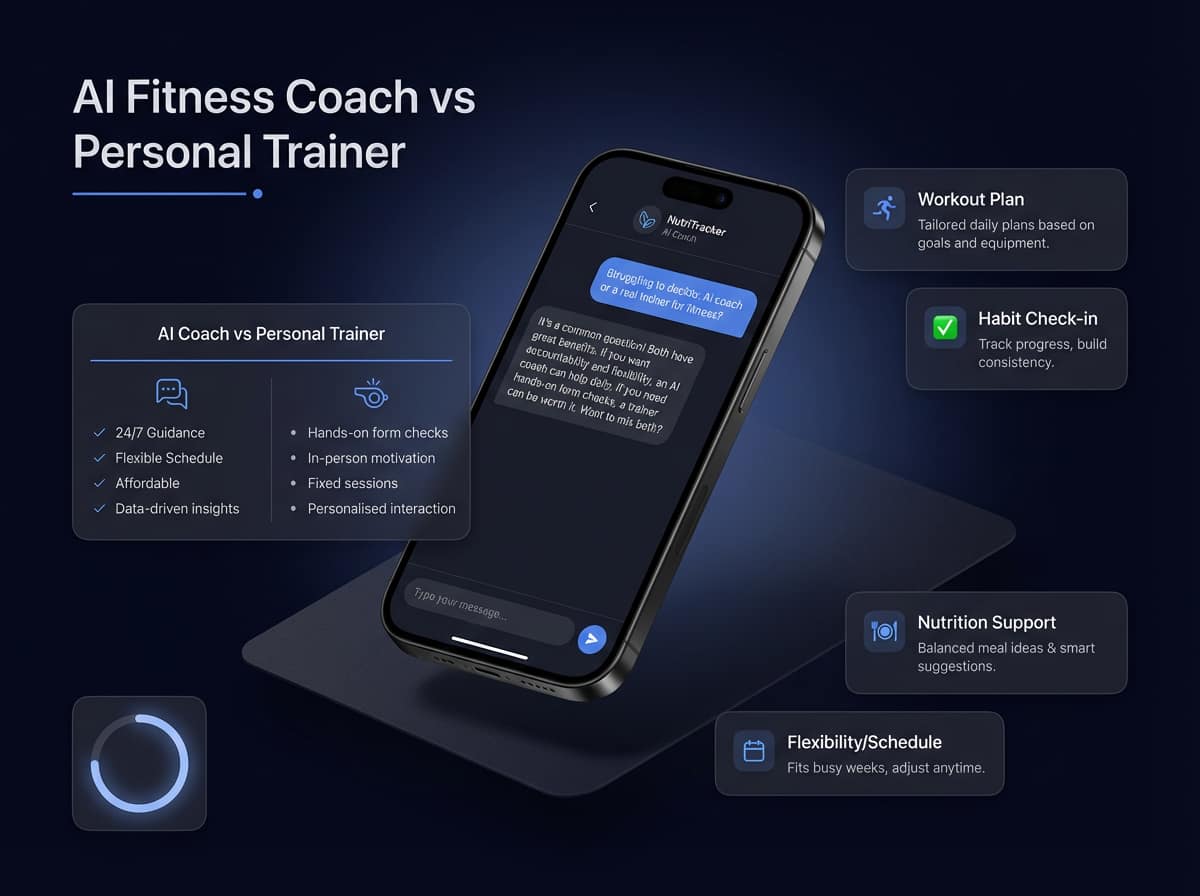
The difference between an AI fitness coach and a personal trainer is that an AI coach gives flexible, everyday support through an app, while a personal trainer provides hands-on coaching, form feedback, and human accountability. The right choice depends on whether you need daily guidance, specialist support, in-person coaching, or a more affordable way to stay consistent.
When comparing an AI fitness coach vs a personal trainer, consider:
- Cost and affordability
- Availability and flexibility
- Workout planning and adjustments
- Nutrition and habit support
- Form correction and technique coaching
- Accountability and motivation
- Whether you need specialist or general support
Fitness coaching is changing
For years, if you wanted fitness coaching, the obvious answer was a personal trainer.
You booked sessions, turned up at the gym, got told what to do, and ideally left feeling slightly stronger and only mildly betrayed by your own legs.
Personal trainers can be brilliant. A good one can teach technique, build a plan, keep you accountable, and spot things you would never notice yourself.
But not everyone needs, wants, or can afford that level of support.
That is where AI fitness coaching comes in.
An AI fitness coach can help with daily guidance, workout adjustments, nutrition habits, consistency, and recovery after off-days. It is not the same as working with a human trainer, but for many people, it can be a more flexible and affordable way to get support.
What is an AI fitness coach?
An AI fitness coach is a digital coach that uses artificial intelligence to provide guidance around workouts, nutrition, habits, activity, and consistency.
A good AI fitness coach can help you:
- Plan workouts around your schedule
- Adjust when you miss sessions
- Build healthier eating habits
- Recover after off-days
- Stay consistent when life gets busy
- Ask questions when you need quick support
- Use health and activity data as useful context
The main strength of an AI fitness coach is availability. You can ask for help when you need it, not just during a booked session.
That matters because fitness decisions usually happen in ordinary moments. What to eat after a long day. Whether to train when you are tired. How to restart after missing a week. What to do when the plan no longer fits your schedule.
What does a personal trainer do?
A personal trainer is a human coach who helps with exercise programming, technique, motivation, accountability, and progress.
A good personal trainer can help you:
- Learn correct exercise form
- Train safely and effectively
- Follow a structured workout plan
- Build confidence in the gym
- Stay accountable to scheduled sessions
- Adjust training based on progress
- Work around injuries or limitations, where qualified to do so
The main strength of a personal trainer is human observation. They can watch how you move, correct technique, read body language, and give real-time feedback.
That is difficult for an app to fully replace.
AI fitness coach vs personal trainer: quick comparison
| Feature | AI fitness coach | Personal trainer |
|---|---|---|
| Cost | Usually lower | Usually higher |
| Availability | Available anytime through an app | Limited to sessions or check-ins |
| Workout planning | Can suggest and adjust plans | Can create detailed programmes |
| Form correction | Limited | Strong, especially in person |
| Nutrition habits | Can support general habits and choices | Depends on qualification and approach |
| Accountability | Good for frequent prompts and coaching | Strong human accountability |
| Best for | Daily guidance, habits, consistency, flexibility | Technique, structured training, hands-on support |
When an AI fitness coach is the better choice
An AI fitness coach can be a good fit if you want flexible support without booking sessions or paying personal trainer prices.
1. You want help between real-life decisions
Fitness is not just about the workout itself.
It is also about the decisions around the workout:
- Should I train today if I slept badly?
- What should I eat before a workout?
- How do I adjust if I only have 20 minutes?
- What should I do after missing a few days?
- How do I stay consistent when work gets busy?
An AI fitness coach can help with those everyday decisions.
That is useful because a lot of people do not fall off because they lack a plan. They fall off because the plan meets real life and immediately starts sweating.
2. You need affordable support
Personal training can be expensive. For many people, weekly sessions are not realistic.
An AI coach is usually much more affordable, which makes it easier to access regular support.
That does not make it better in every way, but it does make it more available. And available support is often better than perfect support you cannot actually use.
3. You want help with habits, not just workouts
Progress is rarely only about training.
Your food, sleep, stress, steps, motivation, and recovery all affect how consistent you can be.
An AI fitness coach can help connect those dots.
For example, it can help you:
- Build simple nutrition habits
- Recover after overeating
- Stay active on busy days
- Plan shorter workouts
- Notice patterns that keep repeating
That kind of support can be really useful if your main issue is consistency.
4. You prefer private, low-pressure guidance
Some people love in-person coaching. Others find it intimidating.
An AI fitness coach can be a lower-pressure way to start asking questions, building habits, and getting support without feeling watched or judged.
For beginners, that can matter.
Sometimes the first step is not walking into a gym with confidence. Sometimes the first step is asking, “What should I actually do today?” from your phone while sitting on the sofa in gym clothes you may or may not use.
When a personal trainer is the better choice
A personal trainer is still the better option in several situations.
1. You need form correction
This is the biggest one.
If you are new to strength training, learning complex lifts, dealing with discomfort, or unsure whether you are moving correctly, a qualified personal trainer can provide real-time feedback.
An AI coach can explain technique, but it cannot fully replace a trainer watching your form in person.
2. You need hands-on accountability
Some people need the structure of an appointment.
If you know you will show up because someone is waiting for you, personal training can be very effective.
Human accountability is powerful. It is much harder to ignore a person than an app notification. Although some app notifications do try their best to emotionally haunt you.
3. You have specific limitations or injuries
If you have injuries, pain, medical conditions, or specialist requirements, it is worth working with a qualified professional.
Depending on the issue, that may be a personal trainer with the right qualifications, a physiotherapist, a registered dietitian, or another healthcare professional.
AI coaching can support general habits, but it should not replace specialist care.
4. You want detailed programming and supervision
If you are training for a specific sport, competition, or advanced strength goal, a human coach may be a better fit.
Specialist programming requires nuance, feedback, and ongoing adjustment based on performance.
AI can help with general guidance, but high-level coaching still benefits from expert human oversight.
Can an AI fitness coach replace a personal trainer?
An AI fitness coach can replace some parts of personal training for some people, but it does not fully replace a personal trainer.
It can help with:
- General fitness guidance
- Workout ideas
- Habit support
- Nutrition coaching
- Recovery after off-days
- Staying consistent
- Adjusting plans around busy weeks
It cannot fully replace:
- In-person form correction
- Hands-on coaching
- Human judgement in complex situations
- Specialist injury support
- Medical or clinical advice
So the better question is not always “which is better?”
The better question is:
What type of support do you actually need?
Which option is better for weight loss?
Both an AI fitness coach and a personal trainer can help with weight loss, but they help in different ways.
A personal trainer can help by giving you structured workouts, accountability, and support with training consistency.
An AI fitness coach can help by supporting daily habits around food, activity, recovery, and consistency.
For weight loss, the deciding factor is usually not who gives you the hardest workout. It is who helps you stay consistent for long enough.
If you need hands-on accountability and technique help, a personal trainer may be better.
If you need flexible everyday support with food, habits, and off-days, an AI fitness coach may be a better fit.
Which option is better for beginners?
Beginners can benefit from both.
A personal trainer is useful if you want to learn proper form, build gym confidence, and avoid guessing your way through equipment that looks like it was designed by someone with a grudge.
An AI fitness coach is useful if you want an easier starting point, flexible guidance, and support with the habits around fitness.
A good beginner approach might be:
- Use a personal trainer to learn technique if you can
- Use an AI coach for daily questions, habit support, and consistency
- Focus on simple routines before chasing advanced plans
- Build confidence gradually
You do not have to choose one forever. You can use the right support at the right time.
AI fitness coach and personal trainer together
For some people, the best option is both.
A personal trainer can support training quality, form, and accountability. An AI fitness coach can support the rest of the week.
That could look like:
- Seeing a trainer once a week or once a month
- Using an AI coach for food and habit support
- Asking the AI coach how to adapt on busy days
- Using the trainer for technique and progression
- Using the AI coach for recovery after off-days
This combination can work well because fitness does not only happen during sessions. It happens across the whole week.
How NutriTracker fits into this
NutriTracker is built for people who want an AI coach for food, fitness, and real life.
It is not trying to pretend that human coaches are pointless. They are not. A good personal trainer can be incredibly valuable.
NutriTracker is designed for the everyday moments where people usually get stuck:
- What should I do when I miss a workout?
- How do I stay consistent when work gets busy?
- What should I eat if I want to lose weight without obsessive tracking?
- How do I recover after a bad weekend?
- How do I build habits that actually fit my life?
NutriTracker focuses on:
- Chat-first AI coaching
- Food, fitness, and habit support
- Six different coach personalities
- Memory across conversations
- Health and activity context where useful
- Support after off-days
- Consistency over perfection
If you are comparing coaching options, these pages may help:
- Best AI fitness coach app
- AI coach that remembers your goals
- Fitness coaching for busy professionals
- How NutriTracker works
Who should choose an AI fitness coach?
An AI fitness coach may be a good fit if you:
- Want affordable everyday support
- Need help staying consistent
- Prefer flexible guidance through an app
- Want support with food and fitness together
- Do not need hands-on form correction
- Want help recovering after missed days
- Like asking questions as they come up
Who should choose a personal trainer?
A personal trainer may be a better fit if you:
- Need help learning exercise technique
- Want in-person accountability
- Have specific strength or performance goals
- Need close supervision
- Feel unsure or unsafe training alone
- Have injuries or limitations that require professional support
The bottom line
An AI fitness coach and a personal trainer are not the same thing.
A personal trainer is best for hands-on coaching, technique, human accountability, and specialist support. An AI fitness coach is best for flexible daily guidance, habits, nutrition support, and staying consistent when life gets messy.
The right option depends on what you need most.
If you need someone to watch your form, choose a qualified human coach. If you need everyday support with food, fitness, and consistency, an AI fitness coach can be a strong fit.
And if you can use both, even better. Very greedy, but effective.
FAQs about AI fitness coaches vs personal trainers
Is an AI fitness coach better than a personal trainer?
An AI fitness coach is not better than a personal trainer for hands-on coaching, form correction, or specialist support. But it can be better for affordable, flexible, everyday guidance around fitness, nutrition, habits, and consistency.
Can an AI fitness coach replace a personal trainer?
An AI fitness coach can replace some general guidance and habit support for some people, but it does not fully replace a personal trainer. It cannot provide in-person form correction or specialist hands-on coaching.
Is an AI fitness coach good for beginners?
Yes, an AI fitness coach can be useful for beginners who want flexible guidance, simple workouts, nutrition support, and help staying consistent. Beginners who need technique support may also benefit from a personal trainer.
Is a personal trainer worth it?
A personal trainer can be worth it if you need form correction, accountability, confidence in the gym, specialist programming, or hands-on support. The value depends on your goals, budget, and needs.
Can an AI fitness coach help with weight loss?
Yes, an AI fitness coach can help with weight loss by supporting habits around food, activity, workouts, recovery, and consistency. It does not do the work for you, but it can make the next step clearer.
Should I use an AI fitness coach or a personal trainer?
Use a personal trainer if you need hands-on technique support or human accountability. Use an AI fitness coach if you want flexible daily guidance, habit support, and help staying consistent around food and fitness.
Want flexible coaching for food, fitness, and real life?
NutriTracker gives you an AI coach that helps you build habits, stay consistent, and make better choices without needing a perfect routine.