Most weight loss apps are built around tracking: log your food, count your calories, hit your target, repeat. For some people, this works. For many, it creates an all-or-nothing cycle — perfect days followed by guilt-ridden off days, until you stop using the app entirely.
AI coaching takes a different approach. Instead of tracking numbers and hoping you figure out what to do with them, a coaching app gives you personalised guidance, helps you make better everyday decisions, and adapts when life gets in the way.
Why tracking alone often fails for weight loss
Calorie tracking apps are powerful tools, but they share a common limitation: they tell you what happened, not what to do about it. You can see that you ate 2,500 calories yesterday, but the app does not tell you why, whether it matters in the context of your week, or what to change tomorrow.
Common failure patterns with tracking-only approaches:
- All-or-nothing thinking. One bad meal becomes a bad day. A bad day becomes “I will start again on Monday.” A week off becomes dropping the app entirely.
- Data without meaning. Numbers on a screen do not explain whether a 200-calorie surplus matters this week, or whether your protein is actually sufficient for your training load.
- No adaptation. Static targets do not account for holidays, illness, schedule changes, or the simple reality that life is not consistent.
- Guilt loops. Seeing red numbers, broken streaks, and “over target” warnings creates negative associations with the very tool that is supposed to help.
This is not a criticism of tracking — it is a recognition that tracking alone is incomplete. Data needs interpretation, and interpretation needs context.
How an AI Coaching App Handles Weight Loss Differently
Data + meaning + action
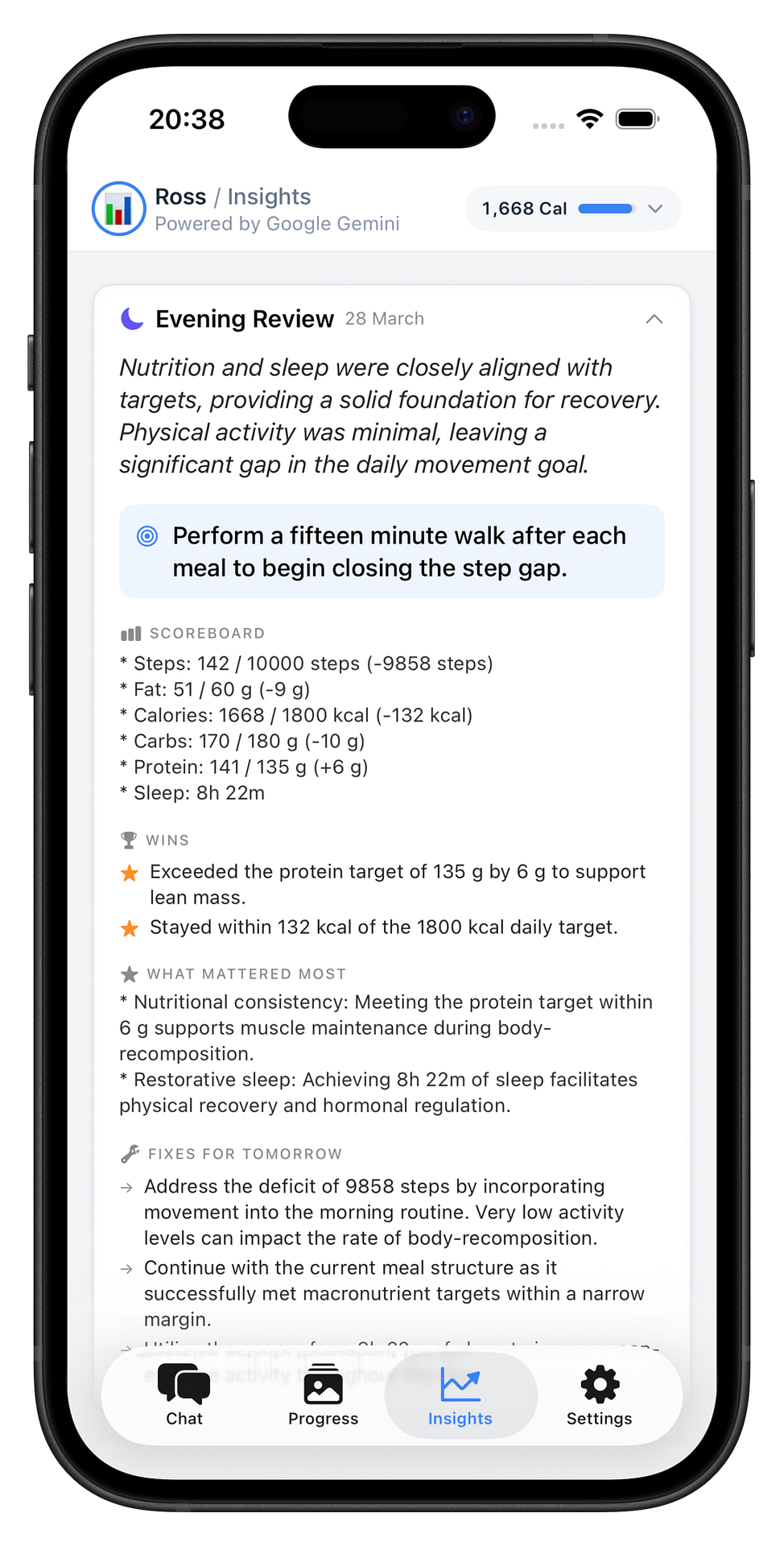
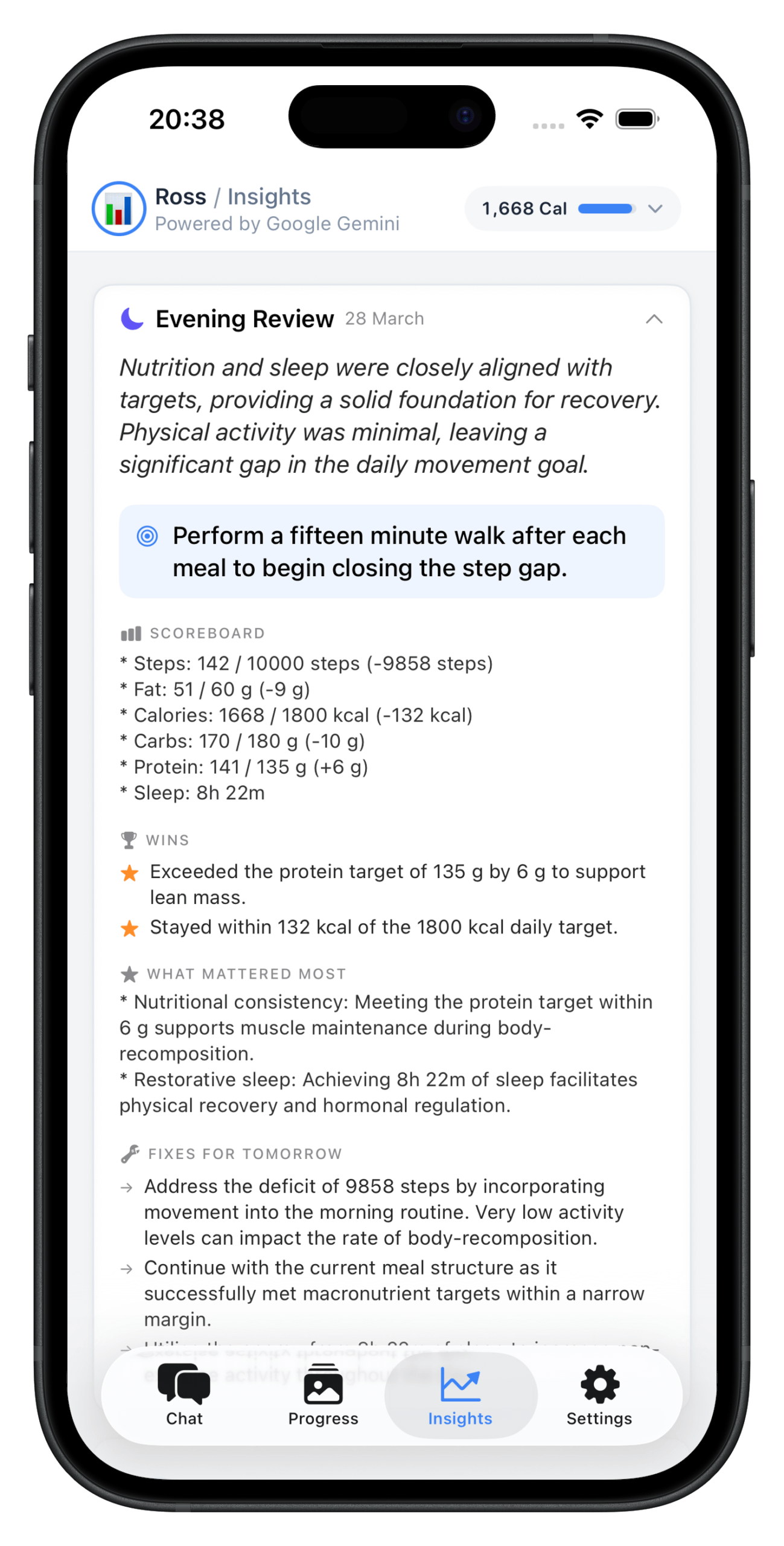
A good AI coach does not just show you the numbers. It explains what they mean in the context of your goals and tells you what to do next. Instead of “you ate 2,500 calories” you get “you were slightly above target, but your protein was strong and your weekly average is still in range — here is what to focus on today.”
This is the difference between a spreadsheet and a coach.
Weekly averages, not perfect days
Weight loss is a weekly and monthly game, not a daily one. A single high-calorie day in an otherwise consistent week has minimal impact on your progress. An AI coach that reviews your week — not just your day — helps you maintain perspective and avoid the guilt-spiral that kills consistency.
Adaptive guidance
Holiday? Illness? Work stress? A good AI coach adjusts recommendations based on what is actually happening in your life. It does not guilt you for missing a day — it helps you reset and refocus. This adaptability is critical for sustainable weight loss, because life will always throw disruptions at your plan.
Coaching through setbacks
The most important moments in a weight loss journey are not the good days — they are the recovery from bad ones. An AI coach that helps you reset after a difficult week, without shame or starting over, is more valuable than one that celebrates a perfect streak.
Personalised, not generic
An AI coach that connects to your health data (steps, sleep, workouts, nutrition) can make recommendations that are specific to you. Not “eat more protein” but “based on your training load this week, aim for 140g protein — here is how to get there with your usual meals.”
What an AI weight loss coach can help with
- Everyday food decisions. What to pick at a restaurant, whether to eat more on training days, what to prioritise when time is short.
- Understanding your patterns. Your coach spots trends — weekend overconsumption, low protein on busy days, poor sleep affecting appetite — and helps you address them.
- Keeping perspective. Coaching memory means your coach can compare this week to last month and show you progress you might not see day-to-day.
- Adjusting your plan. As your weight changes, your calorie needs change. An AI coach adjusts recommendations as you progress rather than locking you into a static target set on day one.
- Building habits, not just hitting numbers. Sustainable weight loss comes from consistent habits, not perfect adherence to a calorie target. An AI coach focused on habit-building creates lasting change.
What an AI coach cannot do for weight loss
It is important to be honest about limitations:
- It cannot replace medical advice. If you have a medical condition affecting your weight, work with your doctor. An AI coach is a supplement, not a replacement.
- It cannot guarantee specific outcomes. Weight loss depends on many factors, including genetics, hormones, stress, and sleep. No coach — human or AI — can guarantee specific results.
- It is not therapy. If your relationship with food is tied to emotional patterns or disordered eating, please work with a professional who specialises in this. An AI coach can support healthy habits but should not be your primary resource for complex food-related mental health challenges.
Choosing an AI coaching approach for weight loss
If you want to try AI coaching for weight loss, look for:
- Coaching, not just tracking. The app should give you guidance and recommendations, not just show you numbers.
- Weekly perspective. Daily numbers without weekly context creates all-or-nothing thinking.
- Memory. Your coach should remember your goals and progress, not start fresh every session.
- A coaching style that fits you. Different coaching styles work for different people. Some want blunt efficiency, others want gentle encouragement.
- Health data integration. Connection to Apple Health, Health Connect, or MyFitnessPal makes guidance specific, not generic.
NutriTracker offers AI nutrition coaching with six coaching personalities, persistent memory, and health data integration. See how it works or start free.