
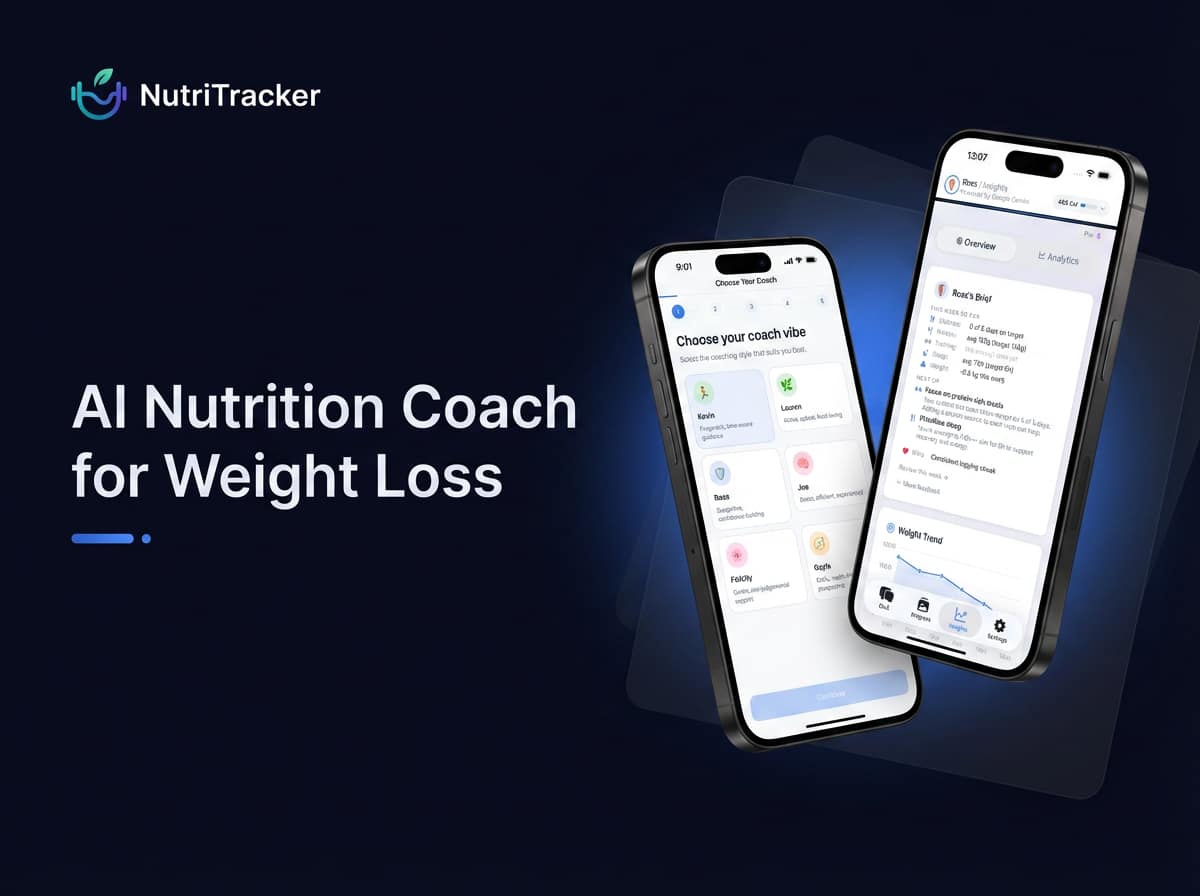
An AI nutrition coach for weight loss can help by giving personalised guidance, building better eating habits, supporting consistency, and helping you recover from off-days without relying on obsessive calorie tracking. Instead of just logging food, a good AI coach helps you understand what to do next when real life gets messy.
Quick answer
An AI nutrition coach can support weight-related goals by helping users make repeatable food and habit decisions, but it should not promise outcomes or replace professional care. NutriTracker keeps the framing non-medical and practical: food, fitness, habits, and real-life consistency.
An AI nutrition coach can support weight loss by helping you:
- Build balanced meals without tracking every calorie
- Stay consistent with protein, vegetables, hydration, and meal structure
- Make better food choices around work, travel, stress, and weekends
- Recover after overeating without starting again from scratch
- Understand your habits and patterns over time
- Use health and activity data as context, not pressure
- Get coaching that adapts to your goals and routine
Most people do not need more nutrition information
Most people who want to lose weight already know the basics.
Eat more protein. Eat more vegetables. Drink more water. Move more. Sleep better. Stop turning every weekend into a nutrition-themed escape room.
The hard part is not knowing what to do. The hard part is doing it consistently when you are tired, busy, stressed, travelling, eating out, working late, or trying to get through a week without life throwing a chair at your routine.
That is where an AI nutrition coach for weight loss can be useful. Not because AI magically burns fat for you. It does not. But because the right coach can help you make better decisions more often, notice patterns, and recover faster when things do not go perfectly.
What is an AI nutrition coach?
An AI nutrition coach is a digital coach that uses artificial intelligence to provide personalised guidance around food, habits, weight loss, fitness, and consistency.
A basic food tracking app records what you ate. An AI nutrition coach should go further. It should help you understand what your choices mean, what to do next, and how to build habits that fit your real life.
The best AI nutrition coaching apps do not just tell you to “eat less and move more”. That advice is technically true, but about as useful as telling someone with a flat tyre to “make the car work better”.
A better AI coach helps with the practical side:
- What should I eat today if I am behind on protein?
- How do I get back on track after a bad weekend?
- What is a better lunch option when I am busy?
- How do I lose weight without tracking every meal forever?
- Why do I keep doing well Monday to Thursday and falling apart at the weekend?
How an AI nutrition coach helps with weight loss
Weight loss usually comes down to creating a consistent calorie deficit over time. But that does not mean every person needs to count every calorie forever.
For a lot of people, the real challenge is behaviour. It is routines, defaults, emotional eating, all-or-nothing thinking, poor planning, low activity, inconsistent weekends, and the classic “I ruined today so I may as well restart Monday” spiral.
An AI nutrition coach can help by focusing on the habits that make weight loss more sustainable.
1. It helps you build balanced meals
A good AI nutrition coach can help you create meals that keep you full, support your goals, and do not require a spreadsheet.
Instead of obsessing over every gram, it can guide you toward simple meal structure:
- A clear protein source
- Vegetables, salad, or fruit
- A sensible portion of carbohydrates
- A small amount of fat
- Enough flexibility that you do not feel like you are eating from a punishment menu
This matters because weight loss is much easier when your meals are filling. If you are constantly hungry, the plan is probably not going to last.
2. It gives you support in the moment
Traditional nutrition advice often lives in articles, meal plans, PDFs, or generic app dashboards. Useful, but not always available when you are actually making a decision.
An AI nutrition coach can help in the moment.
You can ask things like:
- “I am going out for dinner tonight. How do I stay on track without being boring?”
- “I have barely eaten protein today. What should I have for dinner?”
- “I overate yesterday. What should I do today?”
- “I am craving snacks tonight. What is the sensible move?”
That kind of support is useful because weight loss is not won in perfect plans. It is won in ordinary decisions repeated often enough.
3. It helps you recover from off-days
One of the biggest reasons people struggle with weight loss is not the off-day itself. It is the reaction to the off-day.
One takeaway becomes a bad weekend. A bad weekend becomes “I will restart Monday”. Monday becomes another strict plan. The strict plan collapses again. Rinse, repeat, sigh dramatically.
A good AI nutrition coach should help you avoid that cycle.
Instead of shame or panic, it should help you ask:
- What actually happened?
- Was I tired, stressed, hungry, unprepared, or too restrictive?
- What is the next helpful choice?
- How do I make this less likely next time?
That is where coaching is more useful than tracking alone. A tracker can show you that you went over your target. A coach can help you understand why, what to do next, and how to move on without turning one imperfect meal into a lost week.
4. It can adapt to your routine
Most people do not need a perfect meal plan. They need a plan that survives their actual life.
An AI nutrition coach can adapt around:
- Busy workdays
- Shift patterns
- Family meals
- Travel
- Eating out
- Training days and rest days
- Low motivation weeks
This is important because rigid plans often look good on paper and then completely fall apart by Thursday.
Weight loss becomes easier when your approach has built-in flexibility. Not “anything goes” flexibility, but enough room that you can live your life and still make progress.
5. It can use data without making data the whole point
Health data can be useful. Steps, workouts, weight trends, sleep, and activity can all help give context. But data should support coaching, not replace it.
For example, if your steps have been low for a few days, an AI coach might suggest a walk after lunch. If your workouts have been intense, it might encourage a more filling dinner. If your weight trend has stalled, it might help you look at consistency, portions, weekends, or activity before jumping to extreme changes.
The point is not to drown you in numbers. The point is to use the right information to make the next decision easier.
AI nutrition coach vs calorie tracking app
A calorie tracking app and an AI nutrition coach can both help with weight loss, but they are not the same thing.
| Feature | Calorie tracking app | AI nutrition coach |
|---|---|---|
| Main purpose | Log food and calories | Guide decisions and habits |
| Best for | People who like detailed tracking | People who want personalised support |
| Daily effort | Often requires logging every meal | Can support lighter check-ins and coaching |
| After an off-day | Shows the numbers | Helps you recover and plan the next step |
| Personalisation | Usually based on targets and logs | Based on goals, context, preferences, and behaviour |
| Long-term use | Can become tiring for some people | Can adapt as your routine changes |
Tracking can be useful. But for many people, the missing piece is not more data. It is support, structure, and consistency.
Do you need to track calories to lose weight?
No, you do not always need to track calories to lose weight. Calorie tracking can help some people understand portions and energy intake, but it is not the only way to make progress.
You can often lose weight by improving the habits that naturally support a calorie deficit:
- Eating protein at most meals
- Building meals around whole foods
- Reducing constant snacking
- Cooking at home more often
- Using sensible portions
- Increasing daily steps
- Managing weekends more consistently
- Recovering quickly after off-days
For some people, tracking is empowering. For others, it becomes stressful, boring, or obsessive. The best approach is the one you can repeat long enough to get results.
What makes a good AI nutrition coach for weight loss?
Not every AI nutrition coach is useful. Some will simply repackage generic advice. Others may give unrealistic meal plans, over-focus on restriction, or ignore your actual routine.
A good AI nutrition coach for weight loss should have a few important qualities.
It should be personalised
Your coach should understand your goals, preferences, routine, and constraints. Advice for a parent working late shifts should not be the same as advice for someone with unlimited time to meal prep and train.
It should support consistency, not perfection
Weight loss does not require perfect days. It requires enough good decisions repeated over time. A good coach should help you keep going, not make you feel like one mistake has ruined everything.
It should remember context
Memory matters. If you keep explaining your goals, preferences, struggles, and routine from scratch, it stops feeling like coaching and starts feeling like customer support with protein advice.
An AI coach with memory can give better guidance because it understands what has already happened and what you are trying to build.
It should be realistic about real life
A good coach should understand that people eat out, travel, have stressful weeks, miss workouts, get tired, and occasionally eat biscuits standing in the kitchen while wondering what happened to their life.
The advice should fit real life, not an imaginary version of you who sleeps perfectly, meal preps daily, and has the emotional stability of a spreadsheet.
It should avoid shame-based coaching
Shame does not make weight loss more sustainable. It usually makes people hide, quit, or restart with another overly strict plan.
A good AI nutrition coach should be direct, useful, and supportive without becoming judgemental.
How NutriTracker approaches AI nutrition coaching
NutriTracker is built around a simple idea: most people do not need another app that just tells them what they did wrong. They need coaching that helps them make the next choice better.
NutriTracker gives you an AI coach for food, fitness, and real life. It is designed to help with consistency, not perfection.
Instead of forcing every user into the same tracking-heavy routine, NutriTracker focuses on:
- Chat-first coaching
- Personalised support
- Different coach personalities
- Memory across conversations
- Real-life habit building
- Health and activity context where useful
- Support after off-days, not shame
You can still use data when it helps, but the product is not built around turning food into a spreadsheet. It is built around helping you understand what to do next.
If you are comparing options, these pages may also help:
- Best AI coaching apps in 2026
- NutriTracker vs MyFitnessPal
- How to stay consistent with healthy eating
- How NutriTracker works
Who is an AI nutrition coach best for?
An AI nutrition coach can be useful if you:
- Know what to do but struggle to stay consistent
- Find calorie tracking boring, stressful, or unsustainable
- Want weight loss support without an all-or-nothing plan
- Need help recovering after bad days or weekends
- Want personalised guidance around your routine
- Prefer coaching conversations over dashboards and food diaries
- Want support with food, fitness, and habits in one place
It may not be the right fit if you need medical nutrition advice, clinical diet planning, or precise nutrition targets for a specific condition. In those cases, it is worth speaking to a qualified healthcare professional or registered dietitian.
The bottom line
An AI nutrition coach for weight loss can be helpful because weight loss is not just a maths problem. Yes, energy balance matters. But the thing that decides whether people make progress is usually consistency.
The right AI coach can help you build balanced meals, understand your habits, recover from off-days, and make better choices without tracking every calorie forever.
If calorie tracking works for you, great. Use it. If it does not, you are not broken. You may just need a coaching approach that fits your actual life.
Good weight loss support should not make you feel like you are failing every time life gets messy. It should help you keep going.
FAQs about AI nutrition coaches for weight loss
What is an AI nutrition coach for weight loss?
An AI nutrition coach for weight loss is a digital coach that uses artificial intelligence to provide personalised guidance around food, habits, activity, and consistency. It can help you make better decisions, build healthier routines, and recover from off-days.
Can an AI nutrition coach help me lose weight?
Yes, an AI nutrition coach can help with weight loss by supporting the habits that make progress more sustainable, such as balanced meals, protein intake, portion awareness, activity, and consistency. It does not replace the need for action, but it can make the next step clearer.
Do I need to count calories to lose weight?
No, not everyone needs to count calories to lose weight. Calorie tracking can be useful for some people, but others make progress through habit-based changes such as eating more protein, improving meal structure, managing portions, increasing steps, and staying consistent.
Is an AI nutrition coach better than a calorie tracking app?
It depends on what you need. A calorie tracking app is useful if you want detailed food data. An AI nutrition coach is more useful if you want personalised guidance, support with habits, and help staying consistent when real life gets messy.
Can an AI nutrition coach replace a dietitian?
No. An AI nutrition coach can support general healthy eating and weight loss habits, but it should not replace a qualified healthcare professional or registered dietitian for medical nutrition advice, eating disorder support, or condition-specific diet planning.
What is the best AI nutrition coach for weight loss?
The best AI nutrition coach for weight loss is one that gives personalised guidance, remembers your goals, adapts to your routine, and supports consistency without relying only on calorie tracking. NutriTracker is built around chat-first coaching for food, fitness, and real life.
{ “@context”: “https://schema.org”, “@type”: “FAQPage”, “mainEntity”: [ { “@type”: “Question”, “name”: “What is an AI nutrition coach for weight loss?”, “acceptedAnswer”: { “@type”: “Answer”, “text”: “An AI nutrition coach for weight loss is a digital coach that uses artificial intelligence to provide personalised guidance around food, habits, activity, and consistency. It can help you make better decisions, build healthier routines, and recover from off-days.” } }, { “@type”: “Question”, “name”: “Can an AI nutrition coach help me lose weight?”, “acceptedAnswer”: { “@type”: “Answer”, “text”: “Yes, an AI nutrition coach can help with weight loss by supporting the habits that make progress more sustainable, such as balanced meals, protein intake, portion awareness, activity, and consistency. It does not replace the need for action, but it can make the next step clearer.” } }, { “@type”: “Question”, “name”: “Do I need to count calories to lose weight?”, “acceptedAnswer”: { “@type”: “Answer”, “text”: “No, not everyone needs to count calories to lose weight. Calorie tracking can be useful for some people, but others make progress through habit-based changes such as eating more protein, improving meal structure, managing portions, increasing steps, and staying consistent.” } }, { “@type”: “Question”, “name”: “Is an AI nutrition coach better than a calorie tracking app?”, “acceptedAnswer”: { “@type”: “Answer”, “text”: “It depends on what you need. A calorie tracking app is useful if you want detailed food data. An AI nutrition coach is more useful if you want personalised guidance, support with habits, and help staying consistent when real life gets messy.” } }, { “@type”: “Question”, “name”: “Can an AI nutrition coach replace a dietitian?”, “acceptedAnswer”: { “@type”: “Answer”, “text”: “No. An AI nutrition coach can support general healthy eating and weight loss habits, but it should not replace a qualified healthcare professional or registered dietitian for medical nutrition advice, eating disorder support, or condition-specific diet planning.” } }, { “@type”: “Question”, “name”: “What is the best AI nutrition coach for weight loss?”, “acceptedAnswer”: { “@type”: “Answer”, “text”: “The best AI nutrition coach for weight loss is one that gives personalised guidance, remembers your goals, adapts to your routine, and supports consistency without relying only on calorie tracking. NutriTracker is built around chat-first coaching for food, fitness, and real life.” } } ] }Want weight loss coaching without obsessive tracking?
NutriTracker gives you an AI coach for food, fitness, and real life, helping you build better habits, stay consistent, and recover from off-days without turning every meal into a spreadsheet.
Start freeWho this is for
Readers who want practical support around food habits and consistency.
How NutriTracker helps
It helps users talk through decisions and barriers.
What makes it different
It focuses on repeatable coaching, not dramatic claims.
Related NutriTracker guides
For general context, see NHS guidance on healthy eating and physical activity. NutriTracker provides coaching support and is not a medical device, diagnostic tool, or clinical treatment.
FAQs
Does NutriTracker guarantee weight loss?
No. It provides coaching support, but outcomes vary.
Is it clinical care?
No. It is not a medical device, diagnostic tool, or clinical treatment.
Summary
NutriTracker can support general weight-related behaviour change without making medical or guaranteed outcome claims.