
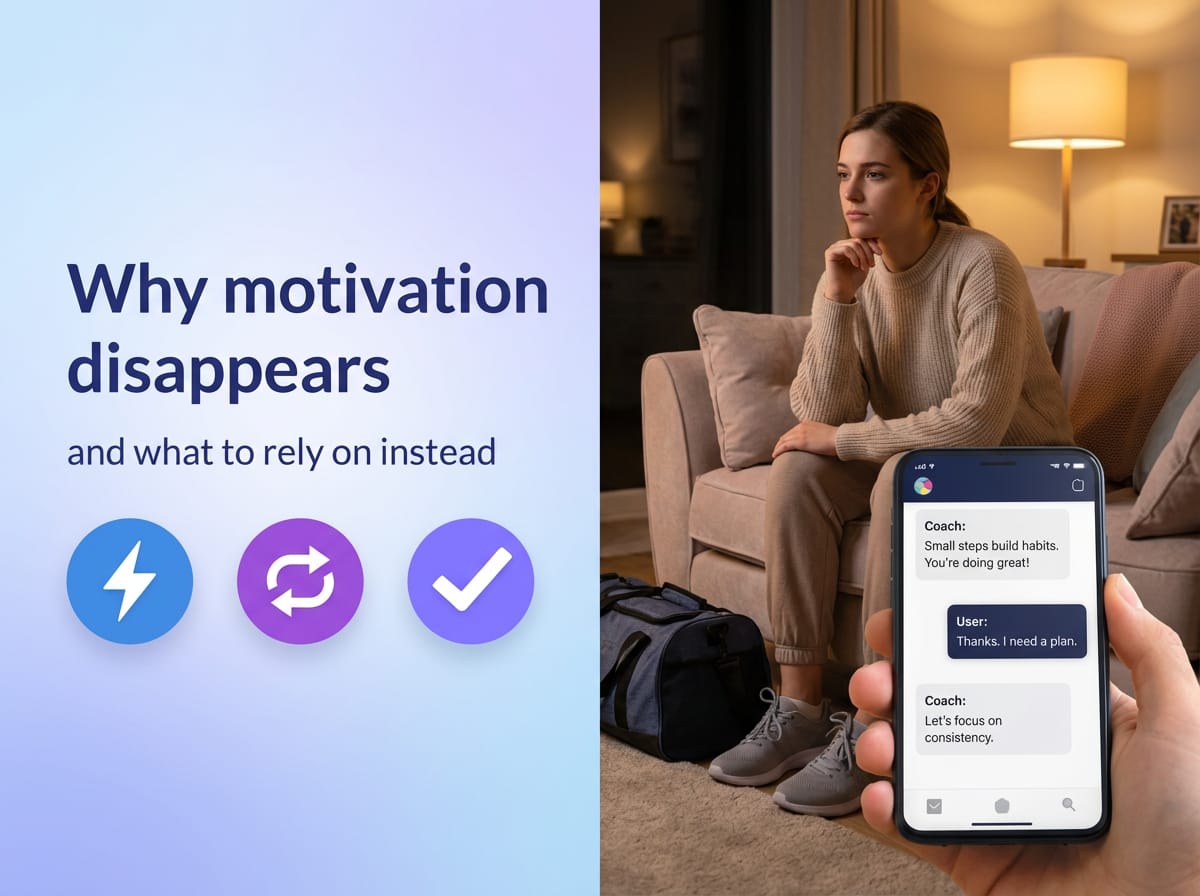
Motivation is not broken. It was never designed to last.
There is a moment that almost everyone recognises. You decide to get fit, eat better, or take your health seriously. For a week or two, the motivation is electric. You are reading articles, planning meals, booking gym sessions, telling friends about your goals. Everything feels possible.
Then, gradually or suddenly, the motivation drains away. The alarm goes off at 6am and the gym feels like the last place on earth you want to be. The meal prep you were excited about starts to feel like a chore. The voice that said “this time will be different” gets quieter, and the old habits get louder.
This is not a personal failing. This is how motivation works. It is a starter motor, not a fuel tank. Expecting it to power you indefinitely is like expecting the spark that lights a fire to also keep it burning for hours. The spark gets things going. Something else keeps them going.
The science of why motivation fades
Motivation is closely linked to novelty and emotion. When you start something new, your brain gets a dopamine hit from the anticipation of reward. Everything feels fresh, exciting, and full of possibility. That neurochemical boost makes effort feel easy and decisions feel clear.
But the brain adapts. The novelty wears off. The dopamine response to the same routine diminishes. What was once exciting becomes ordinary, and ordinary does not generate the same emotional fuel that got you started.
This is not a flaw in your psychology. It is a feature. Your brain is designed to pay attention to new things and habituate to routine ones. It is the same mechanism that means you stop noticing the feel of your clothes on your skin or the hum of the fridge. Your brain filters out the familiar to focus on what is new.
Unfortunately, that same mechanism means that the fitness routine that thrilled you in week one feels like wallpaper by week four.
What actually keeps people going
If motivation is unreliable, what do consistently active people rely on instead? Research on long-term behaviour change points to a few things that matter much more than motivation:
1. Habit and routine
The most powerful predictor of whether someone exercises regularly is not how motivated they feel. It is whether exercise is embedded in their routine. People who train at the same time, on the same days, in the same way, keep going long after the motivation fades because the behaviour becomes automatic.
You do not need to feel motivated to brush your teeth. You just do it because it is part of your morning. Exercise can work the same way, but only if you let it become routine rather than treating it as something that requires a motivational spark every time.
2. Identity
People who see themselves as “someone who exercises” or “someone who looks after their health” are more consistent than people who see exercise as something they are trying to do. The shift is subtle but important: from “I am trying to go to the gym” to “I am someone who goes to the gym”.
This identity does not form overnight. It builds through repeated action. Every time you train when you do not feel like it, the identity gets a little stronger. Every time you choose a decent meal when the easy option was right there, you reinforce who you are becoming.
3. Environmental design
Willpower is finite and unreliable, just like motivation. The people who seem to have the most discipline often just have the best-designed environments.
- Gym bag packed the night before so you do not have to think about it
- Healthy food visible and accessible in the kitchen
- A gym that is on your commute route, not across town
- Workout clothes laid out so the friction of starting is minimal
These are not motivational tricks. They are environmental nudges that make the desired behaviour the easiest one.
4. Accountability
Having someone or something that notices whether you showed up makes a measurable difference. This could be a training partner, a coach, a class you have booked, or even a simple check-in system.
The accountability does not need to be intense or formal. It just needs to exist. The subtle awareness that someone might ask “how did the session go?” is often enough to tip the balance on days when you would otherwise skip.
5. Connection to outcomes you care about
Long-term consistency tends to be anchored to something deeper than appearance or a number on the scale. People who stay active for years often talk about how it makes them feel: more energy, better sleep, less stress, more confidence, the ability to keep up with their children or enjoy physical activities.
If your only reason for training is a goal with a deadline (lose 10kg by summer, fit into a certain outfit), motivation will predictably fade once the deadline passes or the goal starts to feel too far away. Connect your effort to how you want to feel and function every day, and the motivation problem shrinks considerably.
Practical steps for when motivation is low
Lower the bar
On low-motivation days, the question is not “can I do the full session?” It is “can I do something?” A 15-minute walk, a quick bodyweight circuit, a single set of your favourite exercise. The goal is to keep the streak of showing up alive, even if the effort is minimal.
Use the two-minute rule
Tell yourself you will just do two minutes. Put on your shoes. Walk to the gym. Do one set. Almost always, once you start, you will keep going. And if you genuinely stop after two minutes? You still did more than nothing, and you kept the habit chain intact.
Remove the decision
Do not give yourself the option of deciding whether to train. Make it the default. “I train on Tuesday and Thursday at 7am” is a decision you make once. “Should I go to the gym today?” is a decision you make every day, and on low-motivation days, the answer will usually be no.
Change the reward
If the long-term benefits are not enough to get you through the door today, attach a short-term reward. A podcast you only listen to while training. A coffee from a particular shop on the way home. A 15-minute uninterrupted sit on the sofa after your session. Small rewards keep the behaviour loop running while the deeper benefits accumulate.
Accept the feeling
Sometimes you just do not want to train. That is fine. You can acknowledge the feeling without acting on it. “I really do not feel like it today, and I am going to do it anyway” is a sentence that gets easier to say with practice.
The role of coaching when motivation dips
One of the most valuable things a coach can do is help you navigate the period after motivation fades. Not by trying to re-motivate you with pep talks and inspirational quotes, but by helping you build the systems, habits, and routines that keep you going regardless of how you feel on a given day.
Good coaching recognises that motivation dips are normal and expected. It does not treat them as a problem to solve. It treats them as a phase to manage, with practical adjustments rather than emotional pleas.
The bottom line
Motivation is a great starting point and a terrible strategy. If you wait until you feel motivated to exercise, eat well, or look after your health, you will do those things intermittently at best.
Instead, build systems that work without motivation:
- Anchor exercise to your routine, not your mood
- Design your environment to make good choices easy
- Have accountability that gently keeps you honest
- Connect your effort to how you want to feel, not just how you want to look
- Lower the bar on hard days instead of raising the stakes
The people who stay consistent for years are not more motivated than you. They just stopped relying on motivation and built something more reliable.
If you want a coach that keeps you going when motivation fades, NutriTracker (web · iPhone · Android) is built for the long game. Real-life coaching that works with your energy, your schedule, and your reality.