
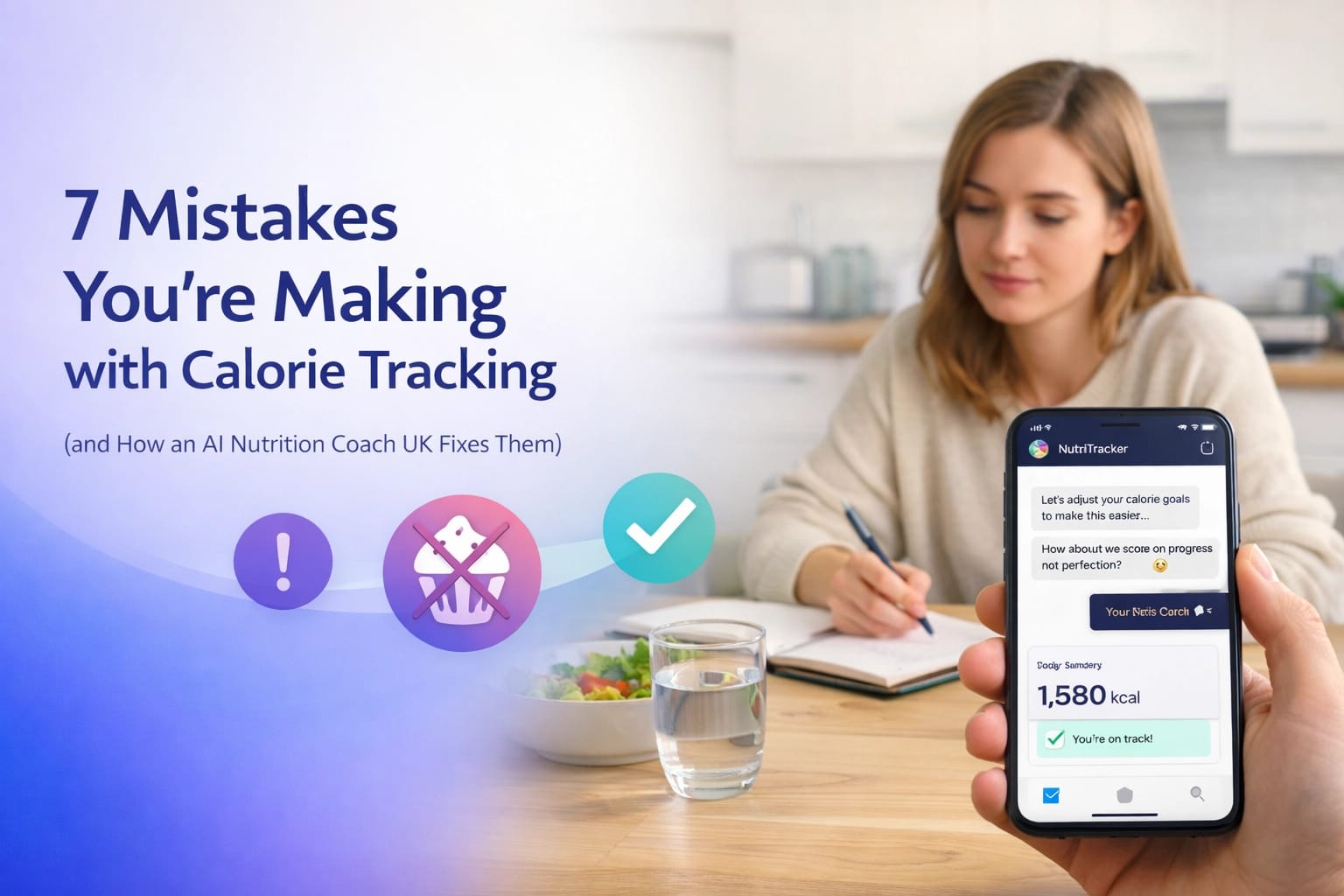
We have all been there. It is 9:00 PM on a Tuesday, you are exhausted after a long commute back from the office, and you are staring at a blank screen on your phone trying to remember exactly how many grams of pasta you had for dinner. Or perhaps you are stood in the middle of a Boots aisle, staring at a meal deal, wondering if that specific wrap is going to “ruin” your progress for the week.
For many of us, traditional calorie tracking feels less like health and more like a second job in data entry. It becomes a spreadsheet exercise that leaves little room for real life, like an impromptu birthday cake at work or a Friday evening pint with friends. At NutriTracker, we believe that your nutrition should support your life, not dictate it.
The shift from a “tracker” to an AI Nutrition Coach is about moving away from the “policing” of food and towards a supportive, visionary partnership. This is exactly why nutrition coaching works better than manual tracking for real life. If you have felt frustrated by the numbers not adding up or the sheer mental load of logging, you are likely falling into one of these seven common traps. Here is how an AI Coach helps you navigate them without the guilt.
1. The “Eyeballing” Error
It is incredibly easy to look at a spoonful of peanut butter or a drizzle of olive oil and think, “that looks like a tablespoon.” In reality, research often shows that most of us are remarkably optimistic when estimating portion sizes. A “heaped” tablespoon of peanut butter can easily be double the calories of a level one.
When you are using a standard spreadsheet-style app, these small errors compound over a week, leading to frustration when the scale does not move. An AI Coach like Ross, who is focused on support and confidence-building, helps you understand these nuances without making you feel like you have failed. Instead of just showing a red bar when you go over, Ross might suggest, “It looks like we might be slightly underestimating those fats, let’s try using a scale for just the high-density items this week to get back on track.” It is about education, not punishment.
2. Forgetting the “Liquid” Context
In the UK, our culture is built around liquids. Whether it is the morning flat white from Pret, a mid-afternoon squash, or a glass of wine to wind down, these calories are often “invisible” to our brains because they do not trigger the same fullness signals as solid food.
A traditional tracker expects you to remember every sip. An AI Coach understands the rhythm of a UK workday. If your AI Coach knows you are a busy professional in London, they might gently prompt you about that afternoon coffee run. It is not about “catching you out,” but about providing the clarity you need to make informed decisions. When you account for the milk in your tea and the sugar in your latte, the “mystery” of why your progress has stalled often disappears.
3. The “Phone Eats Last” Philosophy
One of the biggest mistakes is logging everything at the end of the day. By 10:00 PM, your memory of lunch is hazy at best. Did you have the side of coleslaw? Was that a large or medium portion of chips?
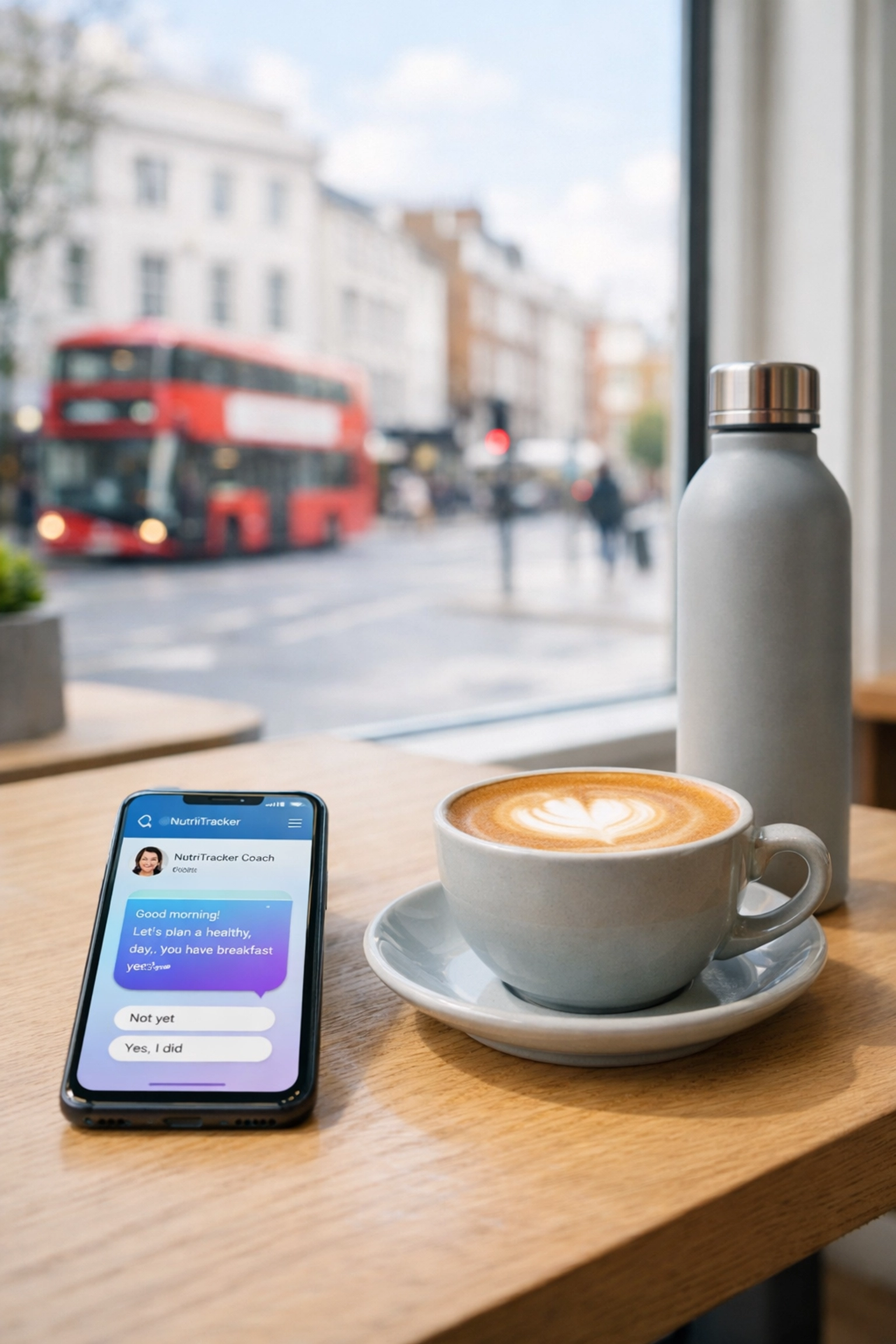
Logging retrospectively turns nutrition into a memory test. At NutriTracker, we encourage a “coach-in-your-pocket” approach where the phone (or rather, the Coach) eats first. By interacting with your AI Coach before or during the meal, you gain immediate insights. If you are at Greggs and about to grab a festive bake, a quick check-in with your Coach can help you decide if that fits your goals for the day or if you might want to balance it out with a high-protein dinner later. This real-time support turns a reactive habit into a proactive lifestyle.
4. The Hidden Impact of Oils and Sauces
You’ve cooked a healthy chicken breast and some steamed broccoli at home. It feels like a “perfect” meal. However, if you used two tablespoons of olive oil to sauté the chicken and added a generous dollop of mayonnaise on the side, you might have added 300 calories that never made it into the log.
Because fats are energy-dense, they are the easiest things to miscalculate. NutriTracker’s AI Coaches, such as Lauren or Kevin, help you build better awareness of these “invisible” additions. They don’t expect you to be a chef with a laboratory, but they provide the practical advice needed to account for the butter on your toast or the oil in the pan. This level of detail is what separates “tracking” from true coaching.
5. Trusting the Label Too Literally
It is a common misconception that every nutrition label is 100% accurate. In reality, there is often a margin of error allowed in food manufacturing. If you become obsessed with being “perfect” down to the single calorie, you are setting yourself up for stress that actually hinders your progress.
Our AI Coaches promote a “practical, not perfect” mindset. They understand that a 10-calorie discrepancy on a sandwich label isn’t what determines your success. What matters is the trend over time. By focusing on the bigger picture (your weekly averages, your protein goals, and your energy levels), the Coach helps you stay calm even when the data feels slightly fuzzy.
6. The “Weekend Blackout”
This is perhaps the most common mistake for the 18-45 demographic. You are “good” from Monday to Thursday, logging every leaf of spinach. Then, Friday evening hits. A few drinks, a takeaway, a Sunday roast, and suddenly the app stays closed until Monday morning.
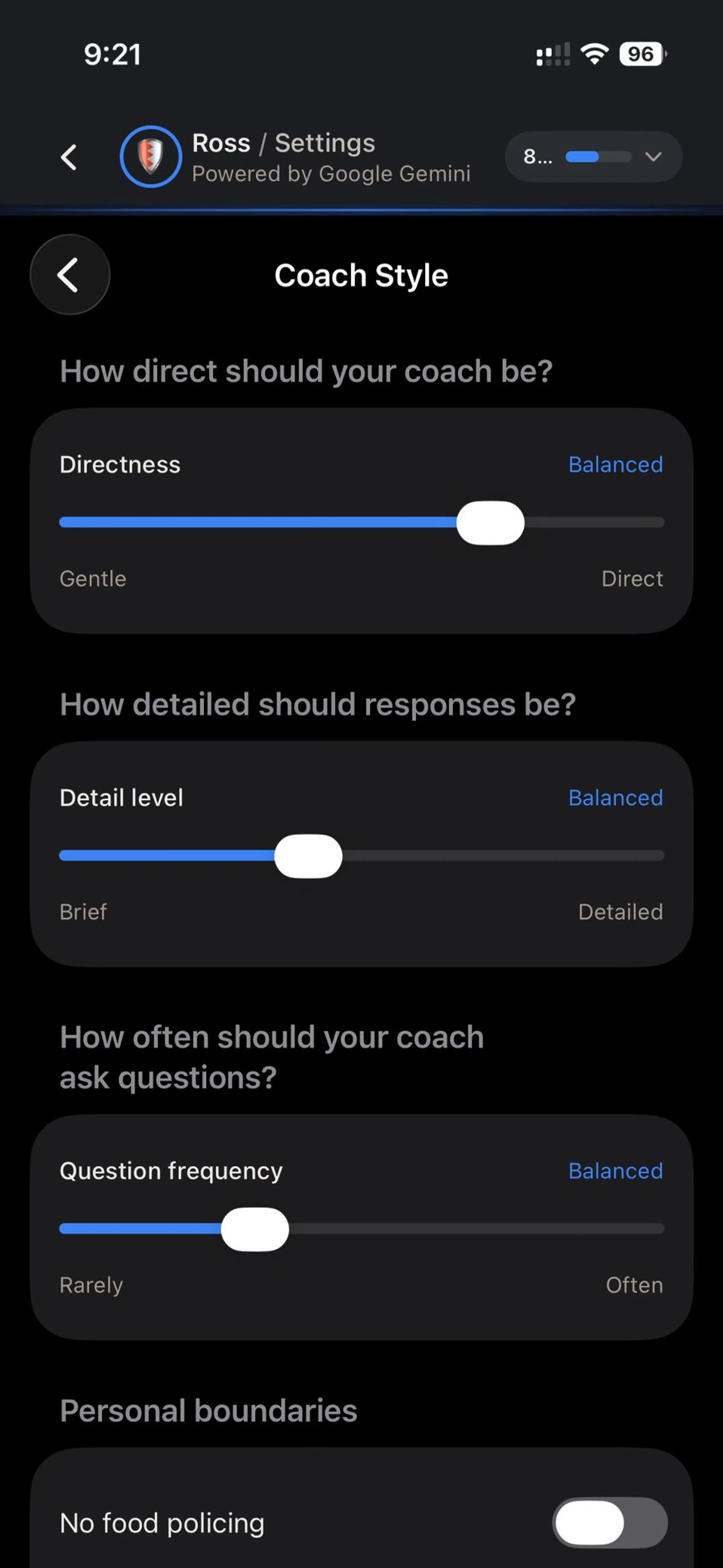
This “all-or-nothing” thinking creates a cycle of guilt. You feel like you have “ruined” it, so you stop engaging. NutriTracker solves this with Life Modes. If you have a big social weekend or you are heading off on holiday, you can switch your Coach to “Holiday” or “Maintenance” mode.
Instead of seeing a sea of red numbers that make you want to quit, your Coach (perhaps Gayle, who is great for steadying the ship) acknowledges that you are in a different phase of the week. They might say, “We’re in Holiday mode, so let’s just focus on staying hydrated and enjoying the food without stress.” This flexibility is key to long-term consistency.

7. Relying on Generic Database Entries
We’ve all searched for “Chicken Curry” and been met with 500 different options ranging from 200 to 1,200 calories. Choosing the lowest one just to make the “bars turn green” is a form of self-deception that eventually leads to a plateau.
An AI Coach helps you navigate this by asking the right questions. Instead of just accepting a generic entry, your Coach might ask, “Was that a home-made curry or a takeaway from the local spot?” Based on your answer, they can help you select the entry that most closely matches reality. For example, if you grabbed a meal deal from Tesco, the Coach knows the specific nutritional profile of that exact item, removing the guesswork and the “spreadsheet friction.”
The Power of Persona-Led Coaching
One of the most visionary aspects of NutriTracker is that you aren’t just talking to an algorithm, you are choosing a coaching style that fits your life.
Take Sarah, a 32-year-old project manager in Manchester. On a high-stress week where she has back-to-back meetings and is relying on Pret lunches, she might choose Ross. Ross is supportive and non-judgemental, helping her find the “easy wins” when she is too tired to cook.
However, during a month when she is training for a 10k and wants to be more precise, she might switch to Kevin. Kevin is more direct and detail-oriented, providing the “tough love” and technical breakdown she needs to hit her performance goals. This ability to switch personas based on your “season of life” is what makes NutriTracker a true partner in your health journey.
Progress Over Perfection
The goal of using an AI Coach is not to become a master of mathematics. It is to build a better relationship with food and your body. When you stop viewing calorie tracking as a pass/fail test, you open the door to sustainable change.
You will have days where you don’t log perfectly. You will have weeks where the “Life Mode” is set to “High Stress” because work is overwhelming. And that is okay. Our AI Coaches are designed to meet you exactly where you are, providing the guidance to get back to baseline without the drama or the “food policing.”
Whether you are trying to lose weight, gain muscle, or simply feel more energetic during your morning commute, the key is consistency over time. If consistency is something you struggle with, the right coach can make all the difference. By avoiding these seven mistakes and leaning into the support of an AI Coach, you turn a tedious task into a visionary path toward your best self.

Medical Safety Note: NutriTracker is designed to support your wellness journey through AI-led coaching and nutritional insights. However, our services do not replace the advice of a doctor or qualified medical professional. If you have a history of disordered eating, a specific medical condition, or an injury, please consult with a healthcare provider before making significant changes to your diet or exercise routine.
Getting Started with Your AI Coach
Ready to move past the spreadsheet and into a coaching experience that actually understands your life? NutriTracker is available to help you navigate the chaos of real life with ease and confidence.
You can start your journey today by visiting our website or heading straight to the web app. NutriTracker is available on iPhone, Android, and Web.
Explore our About Us page to learn more about our “Coach, Not Spreadsheet” philosophy, or dive into more tips on our blog. Your AI Coach is waiting to help you find your “practical, not perfect” balance.