
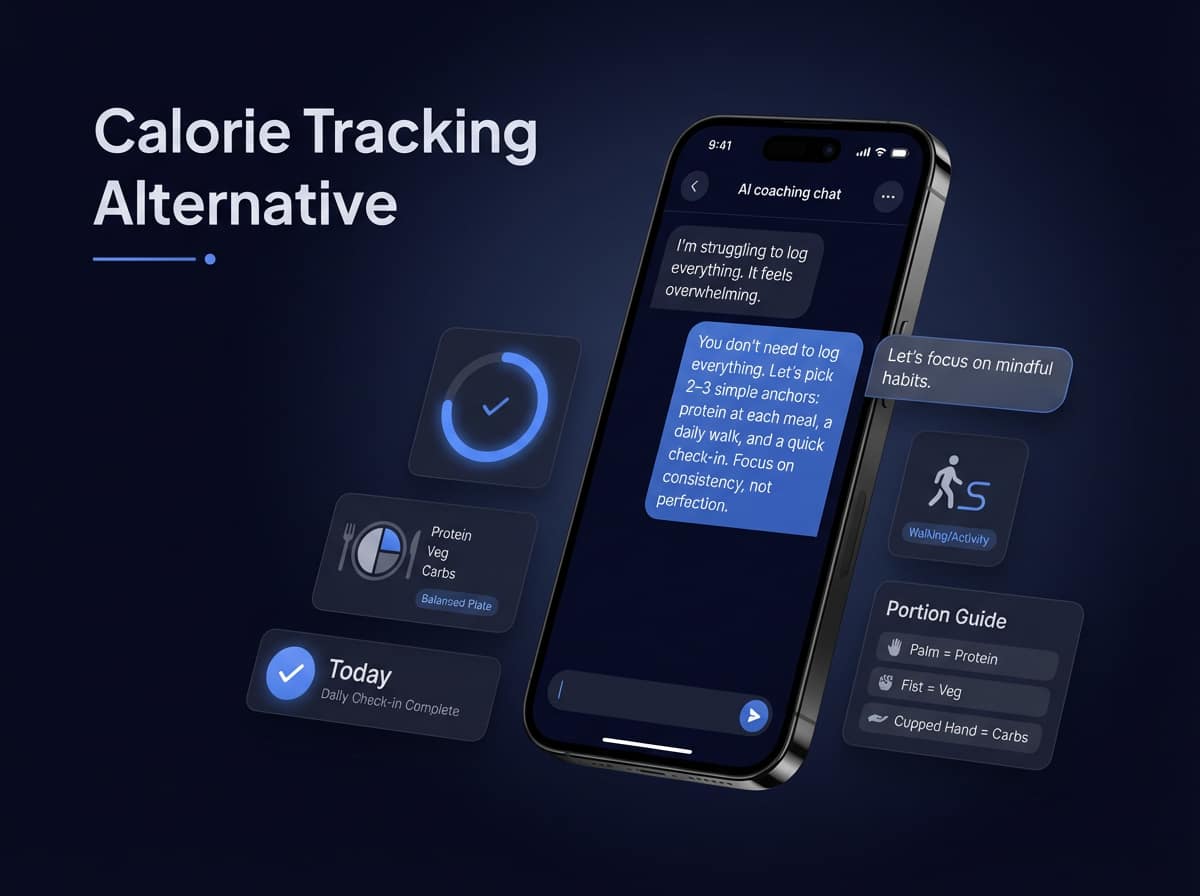
The best calorie tracking alternative is a habit-based approach that helps you make progress without logging every meal. Instead of counting every calorie, you can focus on balanced meals, protein, portion awareness, daily movement, recovery after off-days, and coaching that helps you stay consistent.
Quick answer
An alternative to calorie tracking is an AI coaching approach that helps users make better daily food, fitness, and habit choices without requiring every meal to become a number. NutriTracker supports that through chat-first coaching, memory, and habit-focused check-ins.
Good alternatives to calorie tracking include:
- Using the plate method for balanced meals
- Eating protein at most meals
- Using hand-based portion sizes
- Building a rotation of reliable meals
- Tracking habits instead of calories
- Checking weight trends without obsessing over daily changes
- Using coaching support to stay consistent
Calorie tracking works for some people. It does not work for everyone.
Calorie tracking can be useful. For some people, it gives structure, awareness, and a clearer understanding of portions. It can help you see where your energy intake is coming from and make more informed choices.
But for a lot of people, tracking every meal becomes tiring, stressful, or just painfully boring.
At first, it feels useful. Then it becomes admin. Then you start estimating. Then you miss a few entries. Then the app quietly becomes another icon on your phone that judges you from a distance.
If calorie tracking works for you, great. Use it. But if it does not, that does not mean you cannot make progress. You may just need a calorie tracking alternative that fits your actual life better.
What is a calorie tracking alternative?
A calorie tracking alternative is a way to manage food, habits, weight loss, or nutrition progress without logging every calorie in an app.
Instead of tracking exact numbers, you focus on practical behaviours that usually support better nutrition and a more consistent calorie balance over time.
That might include:
- Building balanced meals
- Eating more protein
- Using simple portion guides
- Cooking at home more often
- Reducing random snacking
- Increasing daily steps
- Planning ahead for busy days
- Recovering quickly after off-days
The goal is not to pretend calories do not matter. They do. The goal is to find a way of making better choices without turning food into a full-time data entry job.
Why people look for alternatives to calorie tracking
Most people do not stop tracking because they are lazy. They stop because the system becomes too much to maintain.
Common reasons include:
- Tracking takes too much time
- Restaurant meals and homemade meals are hard to log accurately
- The numbers become stressful
- One missed day turns into giving up completely
- People start eating for the app instead of eating for real life
- It can encourage all-or-nothing thinking
- It does not always teach recovery after imperfect days
The problem is not always tracking itself. The problem is relying on tracking as the only way to feel in control.
Good nutrition should not collapse the moment you forget to scan a barcode.
Best calorie tracking alternatives
If you want to make progress without logging everything, these are the most useful calorie tracking alternatives to start with.
1. Use the plate method
The plate method is one of the simplest ways to build balanced meals without counting calories.
A good starting point is:
- One-third protein: chicken, fish, eggs, tofu, beans, lentils, Greek yoghurt, turkey, lean beef, or cottage cheese
- One-third vegetables or salad: fresh, frozen, roasted, steamed, or raw
- One-third carbohydrates: rice, potatoes, pasta, oats, bread, wraps, couscous, or sweet potatoes
Then add a small amount of fat, such as olive oil, avocado, cheese, nuts, seeds, or butter.
This approach works because it gives you structure without needing precision. You can look at a plate and know whether it is roughly balanced.
2. Eat protein at most meals
Protein is one of the most useful habits if your goal is weight loss, better nutrition, or staying full for longer.
You do not need to become someone who says “protein” every six minutes and owns five tubs of powder. You just need to make protein a normal part of your meals.
Examples include:
- Eggs or Greek yoghurt at breakfast
- Chicken, tuna, beans, or lentils at lunch
- Fish, tofu, mince, turkey, or prawns at dinner
- Greek yoghurt, hummus, cottage cheese, or a protein bar as a snack
Protein helps because it supports fullness, muscle maintenance, and better meal structure. When meals are more filling, it is usually easier to avoid constant grazing later.
3. Use hand-based portion sizes
If weighing food is not realistic, hand-based portions are a practical alternative.
Use this as a simple guide:
- Protein: one palm-sized portion
- Carbohydrates: one cupped handful
- Vegetables: one or two fist-sized portions
- Fats: one thumb-sized portion
This is not perfect, but it is useful. It gives you a repeatable structure that works at home, in restaurants, and when life is too busy for scales and tracking apps.
Perfectly accurate and completely abandoned is not better than roughly useful and repeatable.
4. Track habits instead of calories
If calorie tracking feels too much, habit tracking can be a better fit.
Instead of asking “how many calories did I eat?”, ask:
- Did I eat protein at most meals?
- Did I eat vegetables or fruit today?
- Did I drink enough water?
- Did I move my body?
- Did I eat slowly and stop when satisfied?
- Did I recover well after an off-plan meal?
These questions are easier to answer and often more useful for long-term consistency.
They also shift the focus from “was today perfect?” to “did I practise the habits that move me forward?”
5. Build a rotation of reliable meals
Most people do not need hundreds of meal ideas. They need a few reliable meals they can repeat without thinking too much.
Decision fatigue is real. When you are tired, hungry, and busy, “what should I eat?” can become the moment where the whole plan collapses.
A useful meal rotation might include:
- Two easy breakfasts
- Three reliable lunches
- Five simple dinners
- A few planned snacks
- One or two backup meals for chaotic days
These become your defaults. Not because every meal needs to be boring, but because defaults save you when motivation has left the building.
6. Use weight trends carefully
You can make progress without tracking calories, but some form of feedback can still help.
For weight loss, body weight trends can be useful when used calmly. The key word there is calmly.
Daily weight can fluctuate because of water, salt, hormones, food volume, training, digestion, stress, and sleep. One weigh-in does not tell the whole story.
A better approach is to look at trends over time:
- Weekly average weight
- How clothes fit
- Energy levels
- Strength and fitness
- Consistency with habits
Data should help you make better decisions. It should not become a tiny bathroom-based emotional ambush.
7. Use coaching instead of just tracking
Tracking tells you what happened. Coaching helps you decide what to do next.
That difference matters.
If you overeat, a calorie tracker can show the number. But a coach can help you understand why it happened and how to recover.
For example:
- Were you too hungry because lunch was too small?
- Did you restrict too much during the week?
- Did stress or tiredness drive the choice?
- Did you have no easy meal ready?
- Did one imperfect meal trigger an all-or-nothing spiral?
This is why an AI coach can be a useful calorie tracking alternative. It can help you build awareness, spot patterns, and make better next choices without requiring you to log every gram.
Calorie tracking vs habit-based coaching
Calorie tracking and habit-based coaching can both support progress, but they work differently.
| Feature | Calorie tracking | Habit-based coaching |
|---|---|---|
| Main focus | Logging food and calories | Building repeatable behaviours |
| Best for | People who like detailed data | People who want sustainable routines |
| Daily effort | Usually requires logging meals | Uses simpler check-ins and habits |
| After an off-day | Shows what happened | Helps you recover and adjust |
| Risk | Can become tedious or obsessive for some people | Can feel less precise if you need exact targets |
| Long-term fit | Works well if you enjoy tracking | Works well if you need flexibility and consistency |
The best option depends on the person. If tracking helps you, keep it. If tracking makes you miserable, you have other options.
Can you lose weight without tracking calories?
Yes, you can lose weight without tracking calories.
Weight loss still requires an energy deficit over time, but calorie counting is not the only way to create one.
You can often make progress by improving the habits that naturally reduce excess intake and increase activity:
- Eating more filling meals
- Increasing protein
- Reducing random snacking
- Cooking at home more often
- Walking more
- Managing weekends better
- Improving sleep and recovery
- Recovering quickly after off-days
This approach is less precise, but it can be much more sustainable for people who hate tracking.
For most people, the best plan is not the most mathematically perfect one. It is the one they can actually keep doing.
When calorie tracking is still useful
Calorie tracking is not bad. It can be genuinely useful in the right context.
It may help if you:
- Want to understand portion sizes
- Have a specific body composition goal
- Need more precise nutrition targets
- Enjoy data and find tracking motivating
- Are not stressed or overwhelmed by logging food
The problem is not using tracking. The problem is thinking tracking is the only valid way to make progress.
You can also use tracking temporarily. For example, track for two weeks to learn more about your eating patterns, then switch to a lighter habit-based approach.
When a calorie tracking alternative may be better
A calorie tracking alternative may be better if you:
- Find tracking stressful or obsessive
- Keep starting and stopping food logs
- Feel guilty when you miss entries
- Want to build long-term habits
- Prefer simple rules over exact numbers
- Want coaching instead of just logging
- Need help with consistency more than information
If tracking makes you feel more in control, use it. If it makes food feel more complicated, a different approach may serve you better.
How NutriTracker works as a calorie tracking alternative
NutriTracker is built for people who want support with food, fitness, and real life without turning every meal into a spreadsheet.
It is not designed to be another app that only asks what you ate and gives you a number back. It is designed to help you understand what to do next.
NutriTracker focuses on:
- Chat-first AI coaching
- Food, fitness, and habit support
- Personalised guidance
- Memory across conversations
- Different coach personalities
- Support after off-days
- Consistency over perfection
You can still use nutrition data when it helps, but the core experience is coaching. That means helping you make better choices, build routines, recover when things go off-plan, and keep moving forward.
If you are comparing options, these pages may help:
- NutriTracker vs MyFitnessPal
- How to stay consistent with healthy eating
- AI nutrition coach for weight loss
- How NutriTracker works
The bottom line
The best calorie tracking alternative is not pretending calories do not exist. It is finding a way to make better choices without needing to log everything forever.
For many people, that means focusing on meal structure, protein, portion awareness, daily movement, habits, and recovery after off-days.
Calorie tracking can be useful, but it is not a personality requirement. You are allowed to make progress without turning lunch into admin.
If tracking works for you, use it. If it does not, build a system that helps you stay consistent in real life.
FAQs about calorie tracking alternatives
What is the best alternative to calorie tracking?
The best alternative to calorie tracking is a habit-based approach that focuses on balanced meals, protein, portion awareness, movement, and consistency. Coaching can also help you understand patterns and recover after off-days.
Can I lose weight without tracking calories?
Yes, you can lose weight without tracking calories. Weight loss still requires an energy deficit over time, but you can create that through better meal structure, portion awareness, increased activity, and consistent habits.
Is calorie tracking necessary?
Calorie tracking is not necessary for everyone. It can be useful for people who like data and want precision, but many people make progress without logging every meal.
What can I do instead of counting calories?
Instead of counting calories, you can use the plate method, eat protein at most meals, use hand-based portions, build reliable default meals, increase steps, and track simple habits.
Is an AI coach a good calorie tracking alternative?
An AI coach can be a good calorie tracking alternative if it helps you build habits, understand patterns, recover after off-days, and stay consistent without needing to log every calorie.
Why do I hate calorie tracking?
You may hate calorie tracking because it feels time-consuming, stressful, repetitive, or too focused on numbers. If it makes healthy eating harder to sustain, a habit-based approach may be a better fit.
{ “@context”: “https://schema.org”, “@type”: “FAQPage”, “mainEntity”: [ { “@type”: “Question”, “name”: “What is the best alternative to calorie tracking?”, “acceptedAnswer”: { “@type”: “Answer”, “text”: “The best alternative to calorie tracking is a habit-based approach that focuses on balanced meals, protein, portion awareness, movement, and consistency. Coaching can also help you understand patterns and recover after off-days.” } }, { “@type”: “Question”, “name”: “Can I lose weight without tracking calories?”, “acceptedAnswer”: { “@type”: “Answer”, “text”: “Yes, you can lose weight without tracking calories. Weight loss still requires an energy deficit over time, but you can create that through better meal structure, portion awareness, increased activity, and consistent habits.” } }, { “@type”: “Question”, “name”: “Is calorie tracking necessary?”, “acceptedAnswer”: { “@type”: “Answer”, “text”: “Calorie tracking is not necessary for everyone. It can be useful for people who like data and want precision, but many people make progress without logging every meal.” } }, { “@type”: “Question”, “name”: “What can I do instead of counting calories?”, “acceptedAnswer”: { “@type”: “Answer”, “text”: “Instead of counting calories, you can use the plate method, eat protein at most meals, use hand-based portions, build reliable default meals, increase steps, and track simple habits.” } }, { “@type”: “Question”, “name”: “Is an AI coach a good calorie tracking alternative?”, “acceptedAnswer”: { “@type”: “Answer”, “text”: “An AI coach can be a good calorie tracking alternative if it helps you build habits, understand patterns, recover after off-days, and stay consistent without needing to log every calorie.” } }, { “@type”: “Question”, “name”: “Why do I hate calorie tracking?”, “acceptedAnswer”: { “@type”: “Answer”, “text”: “You may hate calorie tracking because it feels time-consuming, stressful, repetitive, or too focused on numbers. If it makes healthy eating harder to sustain, a habit-based approach may be a better fit.” } } ] }Want support without logging every meal?
NutriTracker gives you an AI coach for food, fitness, and real life, helping you build better habits, recover from off-days, and stay consistent without turning every meal into a spreadsheet.
Start freeWho this is for
Readers who want a practical alternative to tracking calories.
How NutriTracker helps
It routes readers to the quiz and preserves attribution into registration for AI coaching across food, fitness, and habits.
What makes it different
The primary action is coaching conversation, not logging.
| Approach | Calorie tracking | NutriTracker |
|---|---|---|
| Daily habit | Record intake | Discuss decisions |
| Trial | Varies | 7-day Pro trial, no card needed to start |
Related NutriTracker guides
For general context, see NHS guidance on healthy eating and physical activity. NutriTracker provides coaching support and is not a medical device, diagnostic tool, or clinical treatment.
FAQs
Is this still structured?
Yes. Structure comes from coaching, check-ins, and next steps.
Can I try it free?
Yes. Try Pro free for 7 days. No card needed to start.
Summary
NutriTracker offers AI coaching-led support for food, fitness, and habits as an alternative to calorie tracking.