
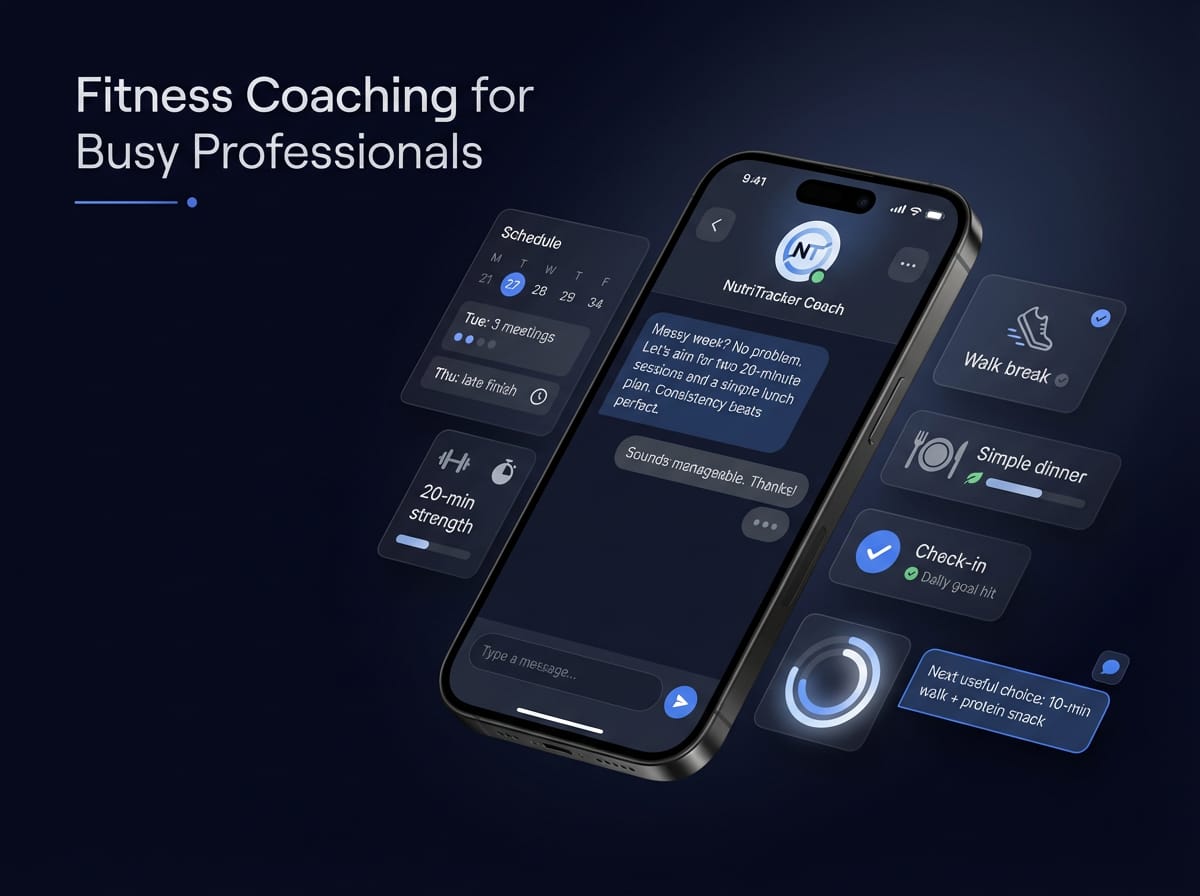
Fitness coaching for busy professionals helps by turning fitness, nutrition, and habits into realistic routines that fit around work, stress, travel, meetings, and inconsistent schedules. The goal is not to follow a perfect plan. The goal is to make enough good choices consistently, even when life gets messy.
Fitness coaching for busy professionals can help you:
- Build shorter workouts around your actual schedule
- Stay consistent when work gets busy
- Plan simple meals without relying on perfect meal prep
- Recover after missed workouts or off-days
- Use small habits to maintain momentum
- Manage weekends, travel, and social meals
- Focus on consistency instead of perfection
Busy professionals do not need more unrealistic fitness plans
If you are busy, the usual fitness advice can feel slightly detached from reality.
Train five times a week. Meal prep every Sunday. Walk 10,000 steps. Sleep eight hours. Stretch. Track your food. Drink enough water. Get sunlight. Journal. Meditate. Somehow also answer emails, attend meetings, commute, manage family life, keep your house vaguely functional, and remember where you put your keys.
Lovely.
The problem is not that the advice is wrong. Most of it is sensible. The problem is that it often assumes you have unlimited time, stable energy, predictable days, and the emotional bandwidth of someone who has never opened their inbox after a bank holiday.
That is why fitness coaching for busy professionals needs to be different.
It has to be realistic, flexible, and focused on the actions that actually move the needle.
Why busy professionals struggle with fitness consistency
Busy professionals usually do not struggle because they know nothing about fitness. Most people know the basics.
Move more. Eat better. Build strength. Get enough sleep. Do not turn every stressful day into a snack-based hostage situation.
The real issue is consistency.
Common barriers include:
- Long workdays
- Early starts or late finishes
- Meetings that destroy your routine
- Travel and commuting
- Low energy after work
- Stress eating
- Unplanned lunches
- Missed workouts that become missed weeks
- All-or-nothing thinking
If your plan only works when your week is calm, it is not a strong plan. It is a fragile one.
Good coaching helps you build a system that still works when your calendar looks like it was attacked by a spreadsheet.
What fitness coaching for busy professionals should include
Fitness coaching for busy professionals should not just be a standard fitness plan with the words “busy lifestyle” added on top.
It should account for real constraints.
1. Shorter workouts that still count
One of the biggest mistakes busy people make is assuming a workout only counts if it is long, complete, and perfectly planned.
That mindset causes a lot of missed sessions.
If you planned a 60-minute workout but only have 20 minutes, the useful move is not to skip it. The useful move is to do the 20-minute version.
A good coaching approach should help you build flexible workout options:
- Full session: 45 to 60 minutes when you have time
- Short session: 20 to 30 minutes when the day is tight
- Minimum session: 10 minutes when you just need to keep the habit alive
This matters because consistency often comes from keeping the routine alive, not doing the perfect version every time.
2. Simple nutrition habits that survive workdays
Busy professionals often do not need complex meal plans. They need reliable defaults.
When work is busy, decision fatigue gets brutal. If you have no plan, the easiest option wins. The easiest option is not always terrible, but it is rarely the carefully balanced meal you imagined on Sunday night.
Useful nutrition habits include:
- Eating protein at breakfast or lunch
- Keeping two easy work lunches you can repeat
- Having a backup meal for late finishes
- Using the plate method instead of tracking everything
- Keeping high-protein snacks available
- Planning social meals without writing off the whole day
The goal is not perfect eating. The goal is fewer chaotic decisions.
3. Recovery after missed workouts
Busy people miss workouts. That is normal.
The problem is not missing one workout. The problem is turning one missed workout into a full identity crisis.
A good fitness coaching system should help you recover quickly.
Instead of:
“I missed the session, so the week is ruined.”
Try:
“What is the next useful action?”
That could be:
- A shorter workout tomorrow
- A walk after lunch
- Moving the session to the weekend
- Doing one set of the most important exercises
- Returning to the normal plan at the next opportunity
Progress is not built by never missing. It is built by not disappearing when you do.
4. Habit systems, not motivation dependency
Motivation is useful, but it is unreliable. Especially after a long workday.
If your fitness plan depends on you feeling motivated at 7pm after back-to-back meetings, good luck. That is not a plan. That is a tiny gamble wearing gym shoes.
Better coaching helps you build systems.
For example:
- Training at the same time on set days
- Keeping gym clothes ready
- Having a default lunch you do not need to think about
- Using walking meetings when possible
- Setting a minimum habit for busy days
- Planning a recovery routine after stressful days
Systems reduce the amount of decision-making required. That makes consistency easier.
The best fitness plan for busy professionals is flexible
A busy professional does not need the most intense plan. They need the most repeatable one.
A good weekly structure might look like this:
| Area | Realistic target | Busy week backup |
|---|---|---|
| Strength training | 2 to 3 sessions per week | 1 to 2 short sessions |
| Walking | Daily steps or regular walks | 10-minute walk after lunch |
| Nutrition | Protein and balanced meals most days | One reliable meal anchor per day |
| Recovery | Regular sleep and downtime | Earlier night once or twice that week |
| Consistency | Follow the main plan | Keep the habit alive with minimum actions |
This is less dramatic than a full transformation plan, but it is much more useful.
The best plan is not the one that looks impressive in a notebook. It is the one that survives a Tuesday.
How to stay fit with a busy schedule
If you are trying to stay fit with a busy schedule, focus on removing friction.
Plan the week before the week attacks you
Look at your calendar before deciding when to train.
If Tuesday is packed, do not pretend Tuesday evening will be your big workout window. You know how that ends. It ends with emails, exhaustion, and a conversation with yourself about whether walking to the fridge counts as cardio.
Instead, choose realistic slots.
- Where are the natural gaps?
- Which mornings or evenings are usually calmer?
- Can one session be shorter?
- Can you move more during the workday?
- What is the minimum version if the plan changes?
Planning around reality beats planning around optimism.
Use meal anchors
A meal anchor is one reliable meal that holds the day together.
For busy professionals, this could be:
- A high-protein breakfast
- A repeatable work lunch
- A simple dinner you can make in 15 minutes
- A backup meal for late finishes
You do not need every meal to be perfect. But one reliable meal can stop the day sliding into chaos.
Keep workouts boring enough to repeat
Not every workout needs to be exciting. In fact, boring can be good.
If your workout is simple, repeatable, and easy to start, you are more likely to do it.
That might mean:
- Two full-body strength sessions per week
- A short home workout
- A walking routine
- A few core exercises you can repeat
- A gym plan with the same basic structure each week
Variety is nice. Repetition is what builds habits.
Use the “minimum useful action” rule
When the day goes wrong, ask:
What is the smallest useful action I can still do?
Examples:
- Walk for 10 minutes
- Do one set of push-ups or squats
- Eat a protein-based dinner
- Drink water before bed
- Prepare tomorrow’s breakfast
- Go to sleep 30 minutes earlier
This rule is powerful because it stops busy days becoming lost days.
Fitness coaching vs fitness tracking for busy professionals
Fitness tracking can be useful, but busy professionals often need more than data.
| Feature | Fitness tracking | Fitness coaching |
|---|---|---|
| Main purpose | Records workouts, steps, or metrics | Helps you decide what to do next |
| Best for | People who like data | People who need support and adaptation |
| Busy weeks | Shows what you missed | Helps you adjust the plan |
| Nutrition | Often requires logging or manual input | Can guide habits and choices |
| Motivation | Usually limited to streaks or reminders | Can provide context, encouragement, and recovery support |
| Long-term value | Useful for history and awareness | Useful for consistency and behaviour change |
Tracking tells you what happened. Coaching helps you work out what to do about it.
For busy people, that difference matters.
Common mistakes busy professionals make with fitness
Busy professionals often make the same few mistakes. Not because they are clueless, but because they are trying to force fitness into a life that is already full.
Trying to do too much at once
Going from nothing to five workouts per week is usually too much. Start with the version you can repeat.
Waiting for a quiet week
If you wait for a quiet week, you may be waiting a very long time. Build the routine around your current life, not the imaginary calm version.
Skipping short workouts
Short workouts count. A 20-minute session is not a failure. It is often the reason the habit survives.
Ignoring weekends
Weekends can undo momentum if they have no structure. You do not need strict rules, but you do need some kind of plan.
Using guilt as motivation
Guilt might get you moving once. It rarely builds a routine. Useful coaching should help you recover, not shame you into a temporary burst of effort.
How NutriTracker supports busy professionals
NutriTracker is built for people who want support with food, fitness, and real life.
That makes it a strong fit for busy professionals who know what to do, but struggle to keep doing it when work, stress, travel, and inconsistent routines get in the way.
NutriTracker can help with:
- Chat-first AI coaching
- Food, fitness, and habit support in one place
- Different coach personalities
- Memory across conversations
- Support after missed workouts or off-days
- Health and activity context where useful
- Consistency over perfection
The aim is not to give you another rigid plan that only works when your calendar behaves. The aim is to help you make better choices inside the week you actually have.
If you are building consistency, these pages may also help:
- Best AI fitness coach app
- Personalised habit coaching app
- AI coach that remembers your goals
- How NutriTracker works
Who this approach is best for
Fitness coaching for busy professionals is useful if you:
- Struggle to fit workouts around work
- Keep starting plans that are too ambitious
- Miss one session and then lose the whole week
- Want help with food and fitness together
- Need realistic habits rather than perfect routines
- Travel, commute, or work inconsistent hours
- Want support that adapts when life changes
It may not be enough if you need injury rehabilitation, medical nutrition advice, or specialist programming for a competitive sport. In those cases, it is worth working with a qualified professional.
The bottom line
Fitness coaching for busy professionals should not be about forcing a perfect routine into an already full life.
It should help you build a system that works when things are busy, imperfect, and slightly chaotic.
That means shorter workouts when needed, simple meal anchors, realistic habits, quick recovery after missed days, and support that helps you keep going.
You do not need a perfect week to make progress. You need a repeatable approach that survives normal life.
FAQs about fitness coaching for busy professionals
What is fitness coaching for busy professionals?
Fitness coaching for busy professionals is support designed around demanding schedules, work stress, travel, and limited time. It helps people build realistic routines for workouts, nutrition, habits, and recovery.
How can busy professionals stay fit?
Busy professionals can stay fit by using shorter workouts, planning around their calendar, eating simple balanced meals, walking more, and focusing on consistency rather than perfection.
What is the best workout plan for a busy professional?
The best workout plan for a busy professional is one that is simple and repeatable. For many people, that means two or three strength sessions per week, regular walking, and shorter backup workouts for busy days.
Can AI fitness coaching help busy professionals?
Yes, AI fitness coaching can help busy professionals by providing flexible guidance, quick adjustments, habit support, and recovery advice when schedules change or routines break down.
How do I exercise when I have no time?
If you have no time, use the minimum useful action rule. Do a 10-minute walk, a short home workout, one strength circuit, or a simple mobility session. Short actions help keep the habit alive.
Is fitness tracking enough for busy professionals?
Fitness tracking can be useful, but it is not always enough. Busy professionals often need coaching that helps them adapt, recover, and make realistic choices when work and life interrupt the plan.
Need fitness coaching that fits real life?
NutriTracker gives you an AI coach for food, fitness, and real life, helping you stay consistent even when work, stress, and busy weeks get in the way.