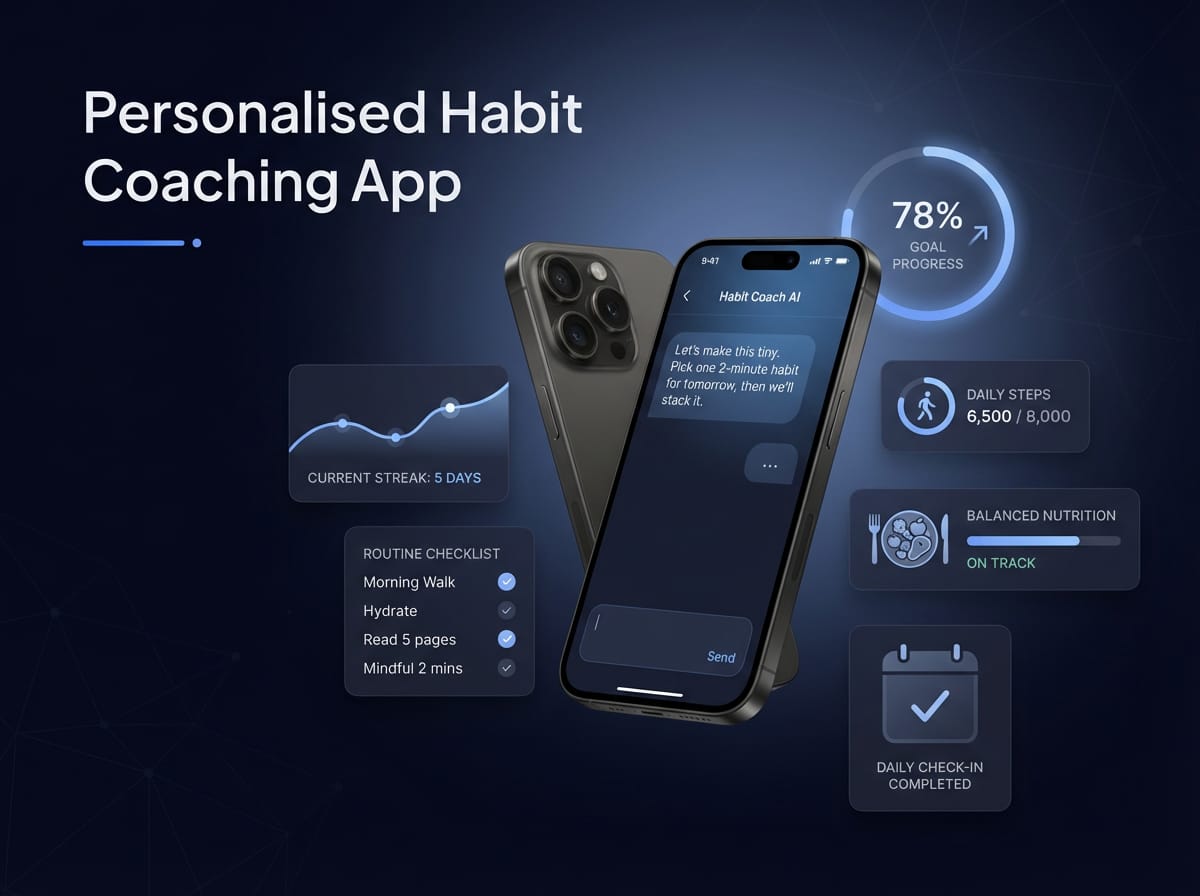
A personalised habit coaching app helps you build routines that actually stick by adapting guidance to your goals, lifestyle, preferences, motivation, and real-life patterns. Instead of giving you generic habit advice, a good coaching app helps you understand what is getting in the way and what to do next.
A personalised habit coaching app can help you:
- Choose habits that fit your actual routine
- Start small enough to stay consistent
- Understand why habits keep breaking down
- Adjust your plan when life gets busy
- Recover after missed days without starting over
- Connect food, fitness, sleep, stress, and motivation
- Build routines around consistency, not perfection
Most habit advice is too generic
Most habit advice sounds sensible until you try to apply it to a real week.
Wake up earlier. Meal prep every Sunday. Train before work. Drink more water. Walk 10,000 steps. Journal. Meditate. Sleep eight hours. Stretch. Read. Cook. Plan. Track. Repeat.
Lovely in theory. Slightly less lovely when you have work, family, stress, low energy, random plans, poor sleep, and a calendar that behaves like it was assembled during a power cut.
The problem is not that habits are useless. Habits are incredibly powerful. The problem is that most habit plans are not personalised enough to survive real life.
That is where a personalised habit coaching app can help.
What is a personalised habit coaching app?
A personalised habit coaching app is a digital coaching tool that helps you build habits around your own goals, lifestyle, preferences, barriers, and behaviour patterns.
Instead of simply saying “do this every day”, a good habit coaching app should help you work out:
- Which habits are worth building first
- How small the habit should be to start
- Where it fits into your existing routine
- What usually gets in the way
- How to recover when you miss a day
- How to adjust the plan as your life changes
This matters because habits do not fail in a vacuum. They fail because they are too big, too vague, too inconvenient, too boring, too strict, or badly matched to the person trying to build them.
Why personalisation matters for habits
Generic habit advice assumes everyone is starting from the same place. They are not.
Someone who works from home has different challenges to someone doing shifts. Someone who loves cooking has different challenges to someone who would rather negotiate with a printer than prep vegetables. Someone who needs direct accountability may not respond to the same coaching style as someone who needs encouragement and patience.
Personalisation matters because the best habit is not the most impressive one. It is the one you can repeat.
Personalised habits fit your real routine
If your current routine is already full, adding five new habits at once is probably not going to work.
A personalised habit coaching app should help you build around what already exists. For example:
- Adding a short walk after lunch instead of promising a 6am gym session
- Preparing one reliable breakfast instead of redesigning your entire diet
- Drinking water with meals instead of tracking every glass
- Doing a 15-minute workout when a full session is unrealistic
Small habits work because they reduce friction. Less friction means more repetition. More repetition means the habit has a chance.
Personalised habits match your motivation style
Some people want a coach who is direct and practical. Some people need reassurance. Some people want structure. Some people want flexibility. Some people hear the phrase “high performance routine” and immediately want to lie down.
A good habit coaching app should not assume one motivational style works for everyone.
Better coaching adapts to how you respond. It should help you feel supported, not managed by a clipboard with Wi-Fi.
Personalised habits adapt when life changes
Real life does not care about your perfect routine. Work gets busy. Sleep goes sideways. Weekends happen. Travel interrupts everything. Motivation drops. Plans change.
A rigid habit plan usually breaks when life changes. A personalised coaching approach adjusts.
That might mean reducing the habit, moving it to a different time, changing the goal for the week, or focusing on recovery instead of pretending everything is still perfectly on track.
How a habit coaching app helps build routines that stick
The right app should do more than remind you to tick a box. Reminders can help, but they are not the same as coaching.
A personalised habit coaching app should help you understand the behaviour behind the habit.
1. It helps you choose the right habit first
One of the biggest mistakes people make is trying to change everything at once.
They decide that from Monday they will eat perfectly, train five times, walk 10,000 steps, sleep eight hours, stop snacking, drink water, meditate, and become a person who owns matching containers.
Then by Thursday, everything collapses.
A better approach is to choose the habit with the highest impact and lowest friction.
For example:
- If your meals are chaotic, start with a reliable breakfast
- If your energy is low, start with a short daily walk
- If your evenings are snack-heavy, start with a proper dinner
- If workouts keep failing, start with two short sessions per week
The right first habit creates momentum. The wrong first habit creates another restart.
2. It makes habits specific
Vague goals are hard to follow.
“Eat healthier” sounds good, but it does not tell you what to do today.
A more useful habit would be:
- Eat protein at breakfast
- Take a 10-minute walk after lunch
- Prepare a simple dinner before ordering takeaway
- Do a 20-minute workout on Tuesday and Thursday
- Drink a glass of water before your morning coffee
Specific habits are easier to repeat because they remove the decision-making. You are not reinventing the plan every day. You already know the next move.
3. It helps you start small enough
Most habit plans fail because they are too ambitious at the start.
Motivation is high, so the plan gets big. Then motivation drops, but the plan stays big. Eventually, the habit starts feeling impossible, and the whole thing gets abandoned.
A personalised habit coaching app should help you scale the habit properly.
Instead of “go to the gym every day”, it might start with:
- Two workouts per week
- A 15-minute home session
- A short walk after work
- One planned meal per day
This is not lazy. It is strategic. A small habit repeated consistently beats an intense plan that lasts six days and then vanishes like a charger in a shared house.
4. It helps you recover after missed days
Missed days are normal. They are not the problem.
The problem is what happens next.
A lot of people treat one missed habit as proof they have failed. Then one missed day turns into a missed week, then a fresh start, then another strict plan, then another collapse.
A good coaching app should help you break that cycle.
Instead of asking “why did I fail?”, it should help you ask:
- What got in the way?
- Was the habit too big?
- Was the timing wrong?
- Did I need a backup version?
- What is the smallest useful action I can take today?
That recovery loop is where habits become sustainable. Not because you never miss. Because you know how to restart without drama.
5. It connects habits across food, fitness, and real life
Habits are connected.
If you sleep badly, your food choices may be harder. If your workouts are too intense, you may feel hungrier. If work is stressful, your evening routine may fall apart. If weekends have no structure, Monday becomes a recovery mission with coffee.
A personalised habit coaching app should understand those connections.
It should help you see patterns like:
- You snack more when lunch is too small
- You miss workouts when they are planned too late
- You overeat on Sundays after restricting during the week
- You lose motivation when your goals are too vague
- You do better when you have default meals ready
Once you can see the pattern, you can change the system.
Habit tracker vs personalised habit coaching app
A habit tracker and a habit coaching app are not the same thing.
| Feature | Habit tracker | Personalised habit coaching app |
|---|---|---|
| Main purpose | Tracks whether you completed a habit | Helps you build, adjust, and understand habits |
| Support after missed days | Usually shows a broken streak | Helps you recover and choose the next step |
| Personalisation | Often limited | Based on goals, routine, preferences, and patterns |
| Best for | People who already know exactly what to do | People who need guidance and adaptation |
| Coaching | Usually minimal | Can provide feedback, context, and habit strategy |
| Long-term usefulness | Good for simple accountability | Better for behaviour change and consistency |
Habit trackers can be useful. But tracking a habit is not the same as knowing how to build it.
If all you need is a checkbox, a tracker is fine. If you need help understanding why your habits keep falling apart, coaching is more useful.
What to look for in a personalised habit coaching app
Before choosing a personalised habit coaching app, look for features that support real behaviour change, not just tidy dashboards.
Personalised coaching
The app should adapt to your goal, routine, preferences, and barriers. It should not give the same advice to everyone.
Memory and context
Memory helps the app remember what you are working on, what you struggle with, and what has helped before. Without memory, every conversation starts from zero.
Flexible habit planning
The app should help you build habits that can shrink, move, or adapt when life changes.
Support after missed days
A good app should not just punish you with a broken streak. It should help you recover quickly and keep going.
Food, fitness, and lifestyle awareness
Habits do not exist in isolation. The app should understand how nutrition, workouts, stress, sleep, and motivation influence each other.
A coaching style that fits you
Some people want direct coaching. Some want encouragement. Some want calm practical advice. The best coaching experience should feel like it actually fits the person using it.
How NutriTracker approaches personalised habit coaching
NutriTracker is built around the idea that people do not need more guilt, more dashboards, or another app that quietly judges them from the corner of their phone.
They need coaching that helps them make the next useful choice.
NutriTracker gives you an AI coach for food, fitness, and real life. It helps you build habits around your actual routine, not an imaginary perfect version of your week.
NutriTracker focuses on:
- Chat-first AI coaching
- Personalised support around food, fitness, and habits
- Six different coach personalities
- Memory across conversations
- Support after off-days and missed routines
- Health and activity context where useful
- Consistency over perfection
The aim is not to make you track everything forever. The aim is to help you understand what works for you, what keeps getting in the way, and what to do next.
If you are comparing options, these pages may help:
- Best AI coaching apps in 2026
- Best AI fitness coach app
- AI nutrition coach for weight loss
- How NutriTracker works
Examples of personalised habits that actually work
The best habits are usually simple, specific, and easy to repeat.
Here are a few examples:
| Goal | Weak habit | Better personalised habit |
|---|---|---|
| Eat healthier | Eat clean every day | Add protein to breakfast Monday to Friday |
| Move more | Exercise every day | Walk for 10 minutes after lunch |
| Lose weight | Stop eating snacks | Have a planned afternoon snack with protein |
| Get fitter | Go to the gym six times a week | Do two strength sessions and one walk each week |
| Improve evenings | Never order takeaway | Keep two default dinners ready for busy nights |
Notice the difference. The better habits are not more dramatic. They are clearer, easier to repeat, and less likely to collapse when life gets busy.
Who should use a personalised habit coaching app?
A personalised habit coaching app can be useful if you:
- Keep starting strong and falling off after a few weeks
- Know what to do but struggle to stay consistent
- Want support with food, fitness, and routines together
- Find generic habit advice too vague
- Need help recovering after missed days
- Prefer coaching conversations over static habit trackers
- Want habits that fit around real life
It may not be enough if you need medical advice, therapy, eating disorder support, injury rehabilitation, or specialist coaching. In those cases, it is worth speaking to a qualified professional.
The bottom line
A personalised habit coaching app can help because habits are not just about willpower. They are about systems, timing, friction, motivation, recovery, and real life.
The best habit is not the one that looks impressive on paper. It is the one you can repeat when your week is busy, your motivation is average, and your plan is being tested by reality.
If a habit keeps failing, you do not always need to try harder. Sometimes you need to make the habit smaller, clearer, better timed, or better matched to your life.
That is what good coaching should help with.
FAQs about personalised habit coaching apps
What is a personalised habit coaching app?
A personalised habit coaching app is a digital tool that helps you build habits based on your goals, routine, preferences, and behaviour patterns. It gives tailored guidance instead of generic habit advice.
How does a habit coaching app help?
A habit coaching app can help by making habits specific, realistic, and easier to repeat. It can also help you understand why habits break down and how to recover after missed days.
Is a habit coaching app better than a habit tracker?
It depends on what you need. A habit tracker is useful for simple accountability. A habit coaching app is better if you need personalised guidance, habit strategy, and support when your routine changes.
What habits can a coaching app help with?
A coaching app can help with habits around food, fitness, walking, workouts, hydration, sleep, planning, consistency, and recovery after off-days.
Can a personalised habit coaching app help with weight loss?
Yes, a personalised habit coaching app can support weight loss by helping you build consistent routines around meals, movement, planning, and recovery. It does not replace action, but it can make the next step easier to repeat.
What makes a good personalised habit coaching app?
A good personalised habit coaching app should adapt to your goals, remember your context, support missed days, offer realistic habit planning, and help you build routines that fit your actual life.
{
“@context”: “https://schema.org”,
“@type”: “FAQPage”,
“mainEntity”: [
{
“@type”: “Question”,
“name”: “What is a personalised habit coaching app?”,
“acceptedAnswer”: {
“@type”: “Answer”,
“text”: “A personalised habit coaching app is a digital tool that helps you build habits based on your goals, routine, preferences, and behaviour patterns. It gives tailored guidance instead of generic habit advice.”
}
},
{
“@type”: “Question”,
“name”: “How does a habit coaching app help?”,
“acceptedAnswer”: {
“@type”: “Answer”,
“text”: “A habit coaching app can help by making habits specific, realistic, and easier to repeat. It can also help you understand why habits break down and how to recover after missed days.”
}
},
{
“@type”: “Question”,
“name”: “Is a habit coaching app better than a habit tracker?”,
“acceptedAnswer”: {
“@type”: “Answer”,
“text”: “It depends on what you need. A habit tracker is useful for simple accountability. A habit coaching app is better if you need personalised guidance, habit strategy, and support when your routine changes.”
}
},
{
“@type”: “Question”,
“name”: “What habits can a coaching app help with?”,
“acceptedAnswer”: {
“@type”: “Answer”,
“text”: “A coaching app can help with habits around food, fitness, walking, workouts, hydration, sleep, planning, consistency, and recovery after off-days.”
}
},
{
“@type”: “Question”,
“name”: “Can a personalised habit coaching app help with weight loss?”,
“acceptedAnswer”: {
“@type”: “Answer”,
“text”: “Yes, a personalised habit coaching app can support weight loss by helping you build consistent routines around meals, movement, planning, and recovery. It does not replace action, but it can make the next step easier to repeat.”
}
},
{
“@type”: “Question”,
“name”: “What makes a good personalised habit coaching app?”,
“acceptedAnswer”: {
“@type”: “Answer”,
“text”: “A good personalised habit coaching app should adapt to your goals, remember your context, support missed days, offer realistic habit planning, and help you build routines that fit your actual life.”
}
}
]
}
Want habits that actually fit your life?
NutriTracker gives you an AI coach for food, fitness, and real life, helping you build routines, stay consistent, and recover from off-days without chasing perfection.