
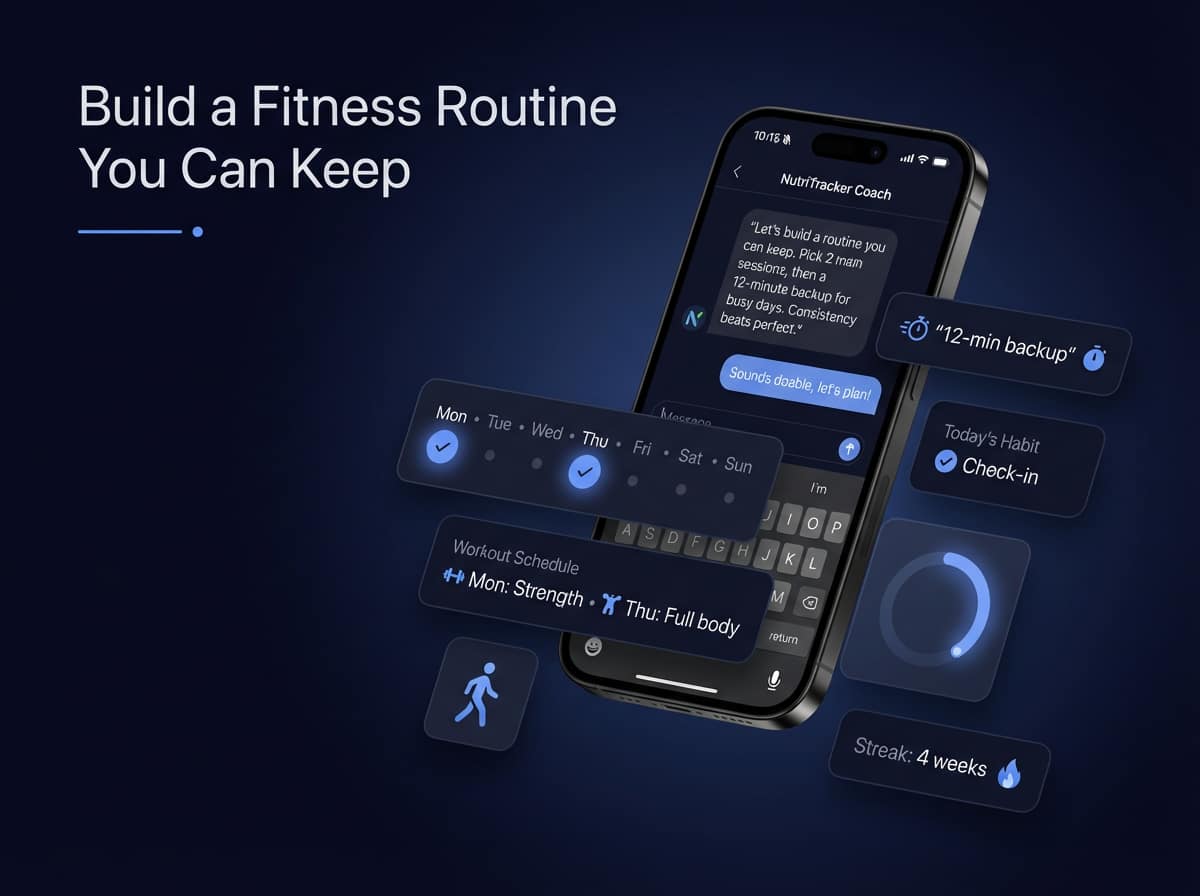
To build a fitness routine you can actually keep, start smaller than you think, choose workouts that fit your real schedule, plan for busy weeks, and focus on consistency rather than perfection. The best fitness routine is not the most intense one. It is the one you can repeat when life is normal, busy, tired, and slightly chaotic.
You can build a fitness routine you can keep by:
- Starting with two or three realistic sessions per week
- Choosing workouts that fit your schedule and energy
- Creating a shorter backup version for busy days
- Linking workouts to existing habits or routines
- Tracking consistency instead of perfection
- Recovering quickly after missed sessions
- Adjusting the routine as your life changes
Most fitness routines fail because they are too ambitious
Most people do not fail at fitness because they are lazy.
They fail because the plan they start with is built for a version of life that does not exist.
Five workouts a week. Meal prep. Perfect sleep. Daily steps. Stretching. Hydration. Protein targets. No missed days. No chaotic work weeks. No family plans. No surprise tiredness. No random Tuesday where your motivation leaves the building and refuses to answer texts.
It looks great on paper.
Then real life gets involved.
If you want to build a fitness routine you can keep, the goal is not to create the most impressive plan. The goal is to create the most repeatable one.
What makes a fitness routine sustainable?
A sustainable fitness routine is one that fits your real life, not your most motivated mood.
It should be:
- Realistic: based on your actual schedule and energy
- Flexible: able to adapt when life changes
- Specific: clear enough that you know what to do
- Repeatable: simple enough to keep doing
- Forgiving: able to survive missed days
The routine does not need to be perfect. It needs to be reliable.
That difference matters because fitness progress is built through repetition. One intense week is less useful than a routine you can keep coming back to for months.
How to build a fitness routine you can actually keep
If you want a routine that lasts, build it around consistency first and intensity second.
1. Start with your real schedule
Before choosing workouts, look at your week honestly.
Not the fantasy version where every evening is calm and you go to bed at 10pm after preparing tomorrow’s lunch like a well-lit productivity advert.
The real version.
Ask yourself:
- Which days are usually busy?
- Which mornings or evenings are realistic?
- When do I usually have the most energy?
- How much time can I actually give this?
- What has failed before?
If your week is busy, do not build a routine that needs five perfect windows. Start with two or three sessions you can realistically complete.
A routine that fits your calendar will beat a routine that only fits your ambition.
2. Choose a minimum number of workouts
Most people start by asking, “What is the ideal routine?”
A better question is:
What is the minimum routine I can repeat consistently?
For many people, that might be:
- Two strength sessions per week
- One or two walks
- One short mobility or recovery session
This might sound too small, but small routines are powerful because they create momentum.
Once the routine feels normal, you can build from there. But if you start too big, you may spend more time restarting than progressing.
3. Build a full version and a backup version
A fitness routine becomes much easier to keep when it has options.
For each workout, create three versions:
| Version | When to use it | Example |
|---|---|---|
| Full version | Normal day with enough time | 45 minute gym session |
| Short version | Busy day | 20 minute home workout |
| Minimum version | Chaotic day | 10 minute walk or one simple circuit |
This helps because life will interrupt the plan.
Without a backup version, a busy day becomes a missed workout. With a backup version, a busy day becomes a smaller workout.
That is how routines survive.
4. Make the routine easy to start
The hardest part of a workout is often starting.
Make the first step obvious and low friction.
For example:
- Put your gym clothes out the night before
- Keep your workout plan simple
- Use the same warm-up every time
- Train at the same time on set days
- Keep home workout equipment visible
- Start with a five-minute rule if motivation is low
The goal is to reduce the amount of thinking required.
If starting the workout requires a full negotiation with yourself, your tired brain will usually win. And your tired brain is very persuasive when snacks are nearby.
5. Focus on repeatable workouts
Your workouts do not need to be wildly different every week.
In fact, repetition is useful.
Repeatable workouts help you:
- Learn movements properly
- Build confidence
- Track progress more easily
- Reduce decision fatigue
- Make the routine feel normal
A simple routine might include:
- Two full-body strength sessions
- Regular walking
- One optional cardio or mobility session
That is not flashy, but it works because it is repeatable.
Fitness progress does not require constant novelty. It requires enough useful effort repeated often enough.
6. Link workouts to existing habits
It is easier to build a routine when the workout has a natural place in your day.
This is sometimes called habit stacking. It just means attaching a new habit to something you already do.
Examples:
- Walk after lunch
- Train after dropping the kids off
- Do mobility after brushing your teeth
- Go to the gym straight after work before going home
- Do a short workout before your evening shower
This works because the routine has a trigger.
Without a trigger, the workout floats around the day until it quietly disappears.
7. Track consistency, not perfection
Do not judge your routine by whether every day was perfect.
Judge it by whether you kept showing up.
Useful questions include:
- Did I complete my planned sessions this week?
- If I missed one, did I recover quickly?
- Did I use a backup version instead of skipping completely?
- Did I move more than I would have without the routine?
- Is this routine still realistic?
This is a much healthier way to measure progress.
If you demand perfection, one missed workout becomes failure. If you measure consistency, one missed workout becomes information.
A simple beginner fitness routine you can keep
If you are starting from scratch, keep it simple.
| Day | Routine | Backup option |
|---|---|---|
| Monday | Full-body strength workout | 20 minute home circuit |
| Tuesday | Walk or light activity | 10 minute walk |
| Wednesday | Rest or mobility | Stretch for 5 minutes |
| Thursday | Full-body strength workout | 20 minute home circuit |
| Friday | Walk or optional cardio | 10 minute walk |
| Weekend | Flexible movement | Walk, chores, light activity, or rest |
This routine is not extreme, which is exactly the point.
It gives you structure without making your life revolve around the gym.
What to do when you miss a workout
You will miss workouts. Everyone does.
The important thing is what happens next.
Do not turn one missed session into a missed week.
Use this simple recovery plan:
- Do not punish yourself
- Look at why it happened
- Choose the next useful action
- Use a shorter session if needed
- Return to the routine at the next opportunity
If you missed a workout because you were busy, tired, or stressed, that does not mean the routine has failed.
It may just mean you need a better backup version.
Fitness routine mistakes to avoid
If your routine keeps falling apart, one of these may be the reason.
Starting too big
Going from nothing to five workouts a week is a lot. Start with the routine you can repeat, then build up.
Relying on motivation
Motivation is useful, but it comes and goes. Systems are more reliable.
Having no backup plan
If your routine only has one version, busy days will break it. Create shorter options.
Changing everything at once
Trying to fix workouts, nutrition, sleep, steps, hydration, and stress at the same time can become overwhelming. Start with the highest impact habit first.
Quitting after missed days
Missing a workout is normal. Quitting because you missed one is the real problem.
Fitness routine vs fitness habit
A routine and a habit are connected, but they are not exactly the same.
| Fitness routine | Fitness habit |
|---|---|
| The planned structure | The repeated behaviour |
| Example: train Monday and Thursday | Example: show up even when motivation is low |
| Gives direction | Creates consistency |
| Can be adjusted | Becomes easier through repetition |
You need both.
The routine tells you what to do. The habit helps you keep doing it.
How NutriTracker helps you build a fitness routine
NutriTracker is built for people who want support with food, fitness, and real life.
That makes it useful if you know what you want to do, but struggle to keep the routine going when life gets busy.
NutriTracker can help you:
- Build realistic routines around your schedule
- Adjust when you miss workouts
- Create smaller backup actions for busy days
- Connect workouts with nutrition and habits
- Recover after off-days without guilt
- Use different AI coach personalities for support
- Focus on consistency over perfection
The goal is not to create a perfect plan. The goal is to help you keep going.
If you are building consistency, these pages may also help:
- Best AI fitness coach app
- Fitness coaching for busy professionals
- Personalised habit coaching app
- AI fitness coach vs personal trainer
Who this approach is best for
This approach is useful if you:
- Keep starting fitness routines and falling off
- Struggle to fit workouts around work or family life
- Need a routine that can survive busy weeks
- Miss one workout and then lose momentum
- Want to build consistency without chasing perfection
- Prefer simple routines over complicated plans
- Need help adjusting when life changes
If you need injury rehabilitation, medical advice, or specialist programming, it is worth working with a qualified professional.
The bottom line
To build a fitness routine you can keep, make it realistic first.
Start small. Choose repeatable workouts. Build backup versions. Link workouts to your existing routine. Recover quickly after missed days.
The best routine is not the one that looks most impressive. It is the one you can keep doing when life is busy, motivation is average, and the sofa is making a very convincing argument.
Consistency beats intensity when intensity only lasts a week.
FAQs about building a fitness routine
How do I build a fitness routine I can stick to?
To build a fitness routine you can stick to, start with two or three realistic sessions per week, choose workouts that fit your schedule, create backup options for busy days, and focus on consistency rather than perfection.
What is a good beginner fitness routine?
A good beginner fitness routine usually includes two full-body strength sessions per week, regular walking, and simple recovery habits. The routine should be easy enough to repeat consistently.
How many days a week should I work out?
Many people can make progress with two or three workouts per week, especially when combined with regular walking and better nutrition habits. The right number depends on your goals, schedule, and current fitness level.
What should I do if I miss a workout?
If you miss a workout, do not punish yourself or restart the whole plan. Choose the next useful action, use a shorter session if needed, and return to your routine at the next opportunity.
How do I stay consistent with fitness?
To stay consistent with fitness, make your routine realistic, reduce friction, use backup workouts, track consistency, and recover quickly after missed days. Consistency improves when the routine fits your real life.
Can an AI fitness coach help me build a routine?
Yes, an AI fitness coach can help you build a routine by suggesting realistic workouts, adjusting plans around your schedule, supporting habits, and helping you recover after missed sessions.
Want help building a routine you can actually keep?
NutriTracker gives you an AI coach for food, fitness, and real life, helping you build realistic habits, adjust when life gets messy, and stay consistent without chasing perfection.