
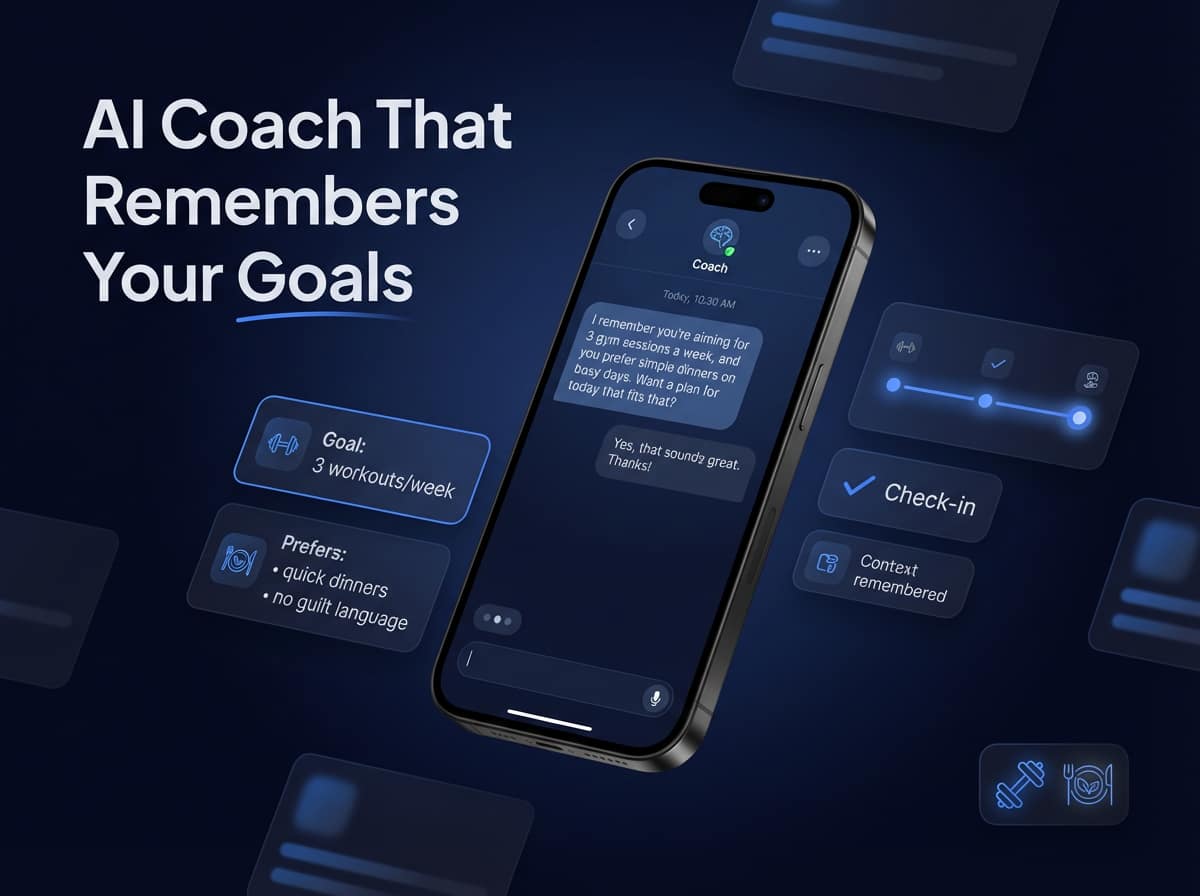
An AI coach that remembers your goals can give better fitness and nutrition support because it keeps track of your preferences, routines, struggles, progress, and previous conversations. Instead of giving generic advice every time, a coach with memory can adapt guidance around your real life and help you stay consistent over time.
Quick answer
An AI coach that remembers your goals can reduce repetition and make future guidance more specific. NutriTracker uses coaching memory so food, fitness, and habit conversations can build over time instead of restarting from scratch.
An AI coach with memory can help by remembering:
- Your fitness and nutrition goals
- Your preferred coaching style
- Your food preferences and dislikes
- Your workout routine and activity patterns
- Your common barriers, such as weekends, stress, or travel
- What has worked for you before
- What you are trying to improve next
Generic advice is easy. Useful coaching needs memory.
Most fitness and nutrition advice is not hard to find.
You can search for meal ideas, workout plans, protein targets, step goals, fat loss tips, habit advice, and motivational quotes until your browser starts quietly judging you.
The problem is not access to information. The problem is that most advice does not know you.
It does not know that you struggle at weekends. It does not know that you hate early workouts. It does not know that you are trying to lose weight without obsessive tracking. It does not know that you prefer direct advice, or that too many questions make you want to close the app and pretend none of this happened.
That is why memory matters.
An AI coach that remembers your goals can provide more useful support because it is not starting from zero every time. It can build on what it already knows and help you make better decisions over time.
What is an AI coach with memory?
An AI coach with memory is a digital coach that can retain useful context across conversations. That context helps the coach personalise guidance instead of treating every chat like the first one.
In fitness and nutrition, memory might include:
- Your main goal
- Your current routine
- Your training preferences
- Your food preferences
- Your motivation style
- Your barriers and patterns
- Your previous check-ins
- Your recent progress
This is what makes coaching feel more joined up. Without memory, the experience can become repetitive very quickly.
If you have to explain your goal, routine, food preferences, and struggles every time you ask for help, it stops feeling like coaching and starts feeling like filling out the same form repeatedly. Which, frankly, should be illegal after 2020.
Why memory matters for fitness and nutrition coaching
Fitness and nutrition are personal. Not in a dramatic “find your inner warrior” way. Personal in the practical sense that your routine, preferences, constraints, and motivation style all change what advice will actually work.
Memory helps an AI coach understand that context.
1. It stops advice feeling generic
Generic advice sounds like this:
- Eat more protein
- Go for a walk
- Get more sleep
- Meal prep on Sunday
- Stay consistent
None of that is wrong. It is just incomplete.
Better coaching sounds more like:
- You usually struggle with protein at breakfast, so let us start there
- You said Sunday meal prep does not work for you, so try two midweek default dinners instead
- Your steps drop when work gets busy, so aim for a short walk after lunch rather than a big evening walk
- You tend to restart after weekends, so focus on one normal meal on Sunday instead of waiting for Monday
That is the difference memory can make. The advice becomes specific enough to use.
2. It helps the coach adapt to your real routine
A plan only works if it fits your life.
If your coach remembers your routine, it can suggest habits and actions that are more realistic.
For example:
- If you work late, it can suggest quick dinners or shorter workouts
- If you travel often, it can help you plan around hotel food and disrupted routines
- If you train in the morning, it can support breakfast and recovery
- If weekends are your weak spot, it can help you build a realistic weekend structure
This is important because most people do not need a perfect plan. They need a plan that survives their week.
3. It supports consistency over time
Consistency is not built from one brilliant answer. It is built from repeated support, useful adjustments, and small decisions that compound.
An AI coach with memory can help spot patterns across time.
For example:
- You do well Monday to Thursday but struggle Friday to Sunday
- You snack more when lunch is too small
- Your workouts drop when your sleep gets worse
- You are more consistent when habits are small and specific
- You respond better to direct coaching than motivational fluff
When a coach remembers these patterns, it can help you adjust earlier instead of waiting until everything has fallen apart.
4. It makes progress feel more personal
People are more likely to stick with coaching when it feels relevant.
If an AI coach remembers what you are trying to build, it can reflect progress back to you in a more meaningful way.
Instead of vague encouragement like “great job”, it can say something more useful:
- You said breakfast was your hardest meal, and you managed protein there four days this week
- You recovered after Saturday instead of waiting until Monday, which is exactly the pattern we are trying to build
- You kept your workouts shorter this week but still completed them, which is better than skipping them completely
That kind of feedback matters because it reinforces the behaviour you are trying to keep.
5. It reduces friction
Repeating context is annoying.
If you have ever had to explain the same issue to three different customer service agents, you know the feeling. Now imagine doing that with your goals, food habits, workout history, and motivation. Delightful. Just what everyone wants.
An AI coach that remembers your goals reduces that friction. You can ask for help without rebuilding the entire backstory first.
That makes it easier to use the coach in the moments where you actually need support.
AI coach with memory vs normal AI chat
A normal AI chat can answer questions. An AI coach with memory can support you over time.
| Feature | Normal AI chat | AI coach with memory |
|---|---|---|
| Main use | One-off answers | Ongoing coaching |
| Context | Often limited to the current chat | Can remember goals, preferences, and patterns |
| Fitness advice | Can be useful but generic | Can adapt around your routine and progress |
| Nutrition support | Can suggest meals or tips | Can consider preferences, struggles, and past behaviour |
| Habit support | Usually advice-based | Can build on previous check-ins and patterns |
| Best for | Quick questions | Long-term consistency and personalised support |
Both can be useful. But if your goal is long-term behaviour change, memory makes the coaching much more practical.
What should an AI coach remember?
An AI coach should not remember random personal details for the sake of it. Useful memory should support better coaching.
In fitness, nutrition, and habits, useful memory includes:
- Goals: weight loss, strength, consistency, energy, healthier eating, or general fitness
- Preferences: foods you like, foods you dislike, workout types, coaching tone
- Constraints: time, work schedule, travel, family routines, access to equipment
- Patterns: weekend struggles, missed breakfasts, evening snacking, low steps on busy days
- Progress: habits you are building, improvements you have made, recent wins
- Barriers: stress, low motivation, poor sleep, all-or-nothing thinking
The point is not to create a creepy digital file of your life. The point is to make the coaching more relevant and less repetitive.
Why memory is especially useful for weight loss
Weight loss is rarely just about knowing what to eat.
Most people trying to lose weight have patterns that repeat:
- Doing well during the week and struggling at weekends
- Skipping meals then overeating later
- Starting strong and falling off after a few weeks
- Using strict rules until they become unsustainable
- Feeling guilty after one imperfect meal
- Waiting until Monday to restart
An AI coach with memory can help because it can recognise those patterns and guide you back to the next useful choice.
For example, if you often restart on Mondays, the coach can remind you that the goal is to continue, not restart. If you snack heavily after small lunches, it can help you build better lunch structure. If weekends are difficult, it can help you plan flexibility instead of pretending weekends are not real.
That is much more useful than generic weight loss advice.
Why memory is useful for fitness routines
Fitness routines fail when they are too ambitious, too vague, or badly matched to the person trying to follow them.
An AI coach that remembers your goals can help you build a routine around your actual life.
It can remember things like:
- You prefer shorter workouts
- You only have equipment at home
- You train better in the evening
- You are trying to build up slowly
- You struggle when the plan is too rigid
- You want support with both workouts and nutrition
This makes fitness guidance more realistic. Instead of pushing a generic plan, the coach can help you adapt and keep moving.
Why memory is useful for healthy eating
Healthy eating advice often falls apart because it ignores preference.
There is no point suggesting a meal plan full of foods you dislike, recipes you will not cook, or routines that do not fit your day.
An AI coach with memory can remember:
- Your preferred meals
- Your usual breakfast or lunch patterns
- Foods you dislike
- Whether you like tracking or hate tracking
- Your common problem times
- Your default meals that work well
That makes healthy eating less about starting from scratch and more about improving the routine you already have.
How NutriTracker uses memory in coaching
NutriTracker is built around chat-first AI coaching for food, fitness, and real life. Memory is a key part of making that coaching feel useful over time.
NutriTracker is designed to help with:
- Remembering your goals and preferences
- Supporting your chosen coach personality
- Building context across conversations
- Helping you recover after off-days
- Supporting consistency rather than perfection
- Using health and activity context where useful
- Keeping guidance practical and personal
This matters because NutriTracker is not trying to be another generic advice app. The aim is to give you coaching that becomes more relevant as it understands your routine, goals, and patterns.
If you are comparing options, these pages may help:
- Best AI coaching apps in 2026
- Best AI fitness coach app
- AI nutrition coach for weight loss
- Personalised habit coaching app
What to look for in an AI coach that remembers your goals
If you are choosing an AI coach, memory is only useful if it improves the coaching experience.
Look for:
- Clear personalisation: the coach should adapt around your goals and routine
- Useful recall: it should remember relevant details, not random noise
- Habit support: it should help you build repeatable behaviours
- Recovery coaching: it should help after off-days and missed routines
- Flexible guidance: it should adjust when life changes
- Supportive tone: it should motivate without shame
- Transparency: you should understand how the app uses context to support you
The best AI coach is not the one that knows the most facts. It is the one that can use the right context to help you take the next useful step.
The bottom line
An AI coach that remembers your goals can be more useful than generic fitness or nutrition advice because it understands context.
Memory helps the coach adapt to your routine, recognise patterns, personalise feedback, and support consistency over time.
For food, fitness, and habits, that matters. Most people do not need another one-off answer. They need help keeping going when real life gets messy.
Good coaching should not make you explain yourself from scratch every time. It should remember enough to help you move forward.
FAQs about AI coaches that remember your goals
What is an AI coach that remembers your goals?
An AI coach that remembers your goals is a digital coach that can retain useful context across conversations, such as your fitness goals, nutrition preferences, routine, struggles, and progress.
Why does memory matter in an AI coach?
Memory matters because it helps the AI coach personalise guidance. Instead of giving generic advice, it can adapt to your goals, preferences, routine, and previous behaviour.
Can an AI coach remember my fitness routine?
Yes, some AI coaching apps can remember your fitness routine, preferences, and activity patterns. This can help the coach suggest more realistic workouts and adjustments over time.
Can an AI coach help with nutrition goals?
Yes, an AI coach can help with nutrition goals by remembering your food preferences, struggles, habits, and previous check-ins, then using that context to guide better choices.
Is an AI coach with memory better than a normal chatbot?
For ongoing coaching, an AI coach with memory is usually more useful than a normal chatbot because it can build on previous conversations instead of starting from zero each time.
What should an AI fitness and nutrition coach remember?
An AI fitness and nutrition coach should remember useful coaching context, such as your goals, preferences, routine, barriers, progress, and what has worked for you before.
{ “@context”: “https://schema.org”, “@type”: “FAQPage”, “mainEntity”: [ { “@type”: “Question”, “name”: “What is an AI coach that remembers your goals?”, “acceptedAnswer”: { “@type”: “Answer”, “text”: “An AI coach that remembers your goals is a digital coach that can retain useful context across conversations, such as your fitness goals, nutrition preferences, routine, struggles, and progress.” } }, { “@type”: “Question”, “name”: “Why does memory matter in an AI coach?”, “acceptedAnswer”: { “@type”: “Answer”, “text”: “Memory matters because it helps the AI coach personalise guidance. Instead of giving generic advice, it can adapt to your goals, preferences, routine, and previous behaviour.” } }, { “@type”: “Question”, “name”: “Can an AI coach remember my fitness routine?”, “acceptedAnswer”: { “@type”: “Answer”, “text”: “Yes, some AI coaching apps can remember your fitness routine, preferences, and activity patterns. This can help the coach suggest more realistic workouts and adjustments over time.” } }, { “@type”: “Question”, “name”: “Can an AI coach help with nutrition goals?”, “acceptedAnswer”: { “@type”: “Answer”, “text”: “Yes, an AI coach can help with nutrition goals by remembering your food preferences, struggles, habits, and previous check-ins, then using that context to guide better choices.” } }, { “@type”: “Question”, “name”: “Is an AI coach with memory better than a normal chatbot?”, “acceptedAnswer”: { “@type”: “Answer”, “text”: “For ongoing coaching, an AI coach with memory is usually more useful than a normal chatbot because it can build on previous conversations instead of starting from zero each time.” } }, { “@type”: “Question”, “name”: “What should an AI fitness and nutrition coach remember?”, “acceptedAnswer”: { “@type”: “Answer”, “text”: “An AI fitness and nutrition coach should remember useful coaching context, such as your goals, preferences, routine, barriers, progress, and what has worked for you before.” } } ] }Want an AI coach that remembers your goals?
NutriTracker gives you an AI coach for food, fitness, and real life, helping you build habits, stay consistent, and get support that adapts over time.
Start freeWho this is for
Readers frustrated by generic AI advice.
How NutriTracker helps
Memory connects past goals with the next coaching conversation.
What makes it different
It aims for continuity, not one-off advice.
Related NutriTracker guides
FAQs
Does memory replace user control?
No. Memory should support the experience while respecting privacy and user preferences.
What should memory improve?
Specificity, continuity, and reduced repetition.
Summary
Coaching memory helps NutriTracker keep guidance connected to the user's goals and routine.