
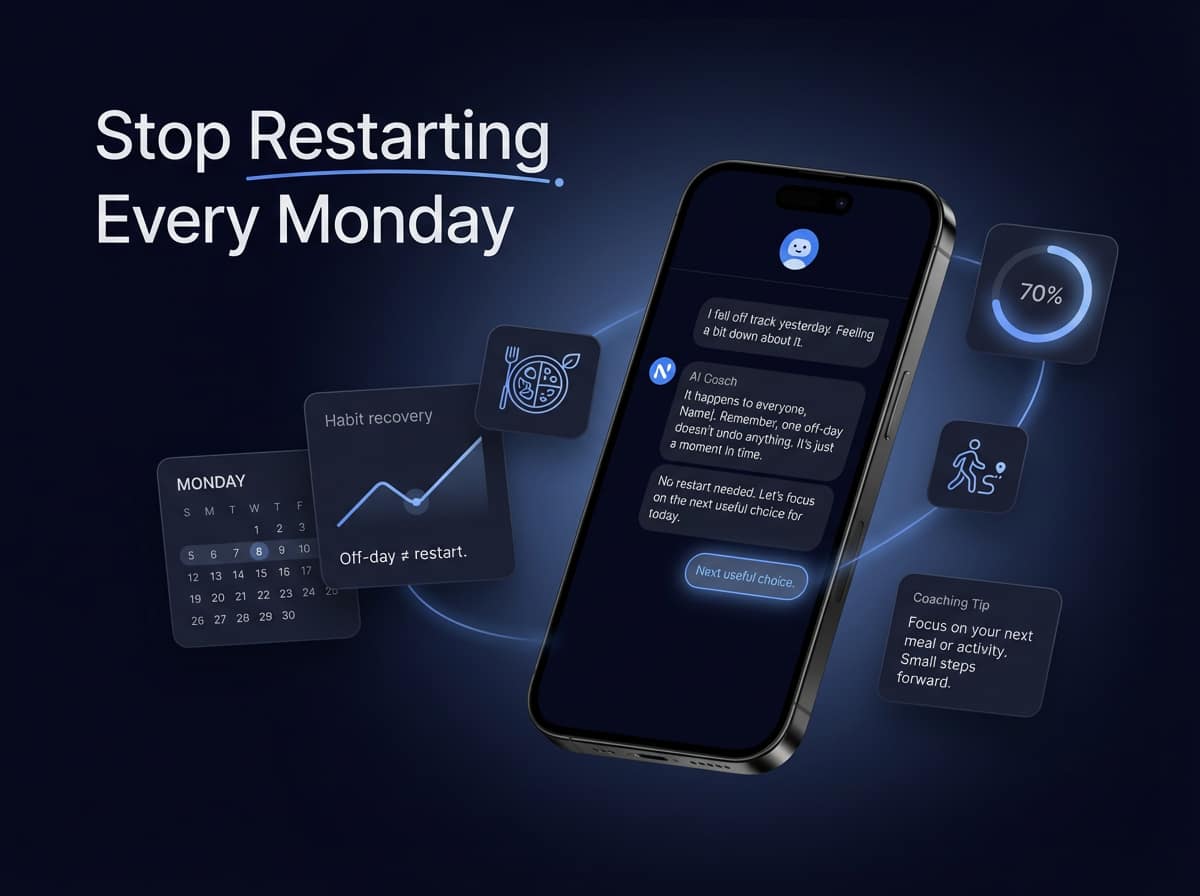
To stop restarting your diet every Monday, you need to break the all-or-nothing cycle. Instead of treating one bad meal, day, or weekend as failure, focus on recovering quickly, building flexible habits, and making the next useful choice without waiting for a fresh start.
You can stop restarting your diet every Monday by:
- Stopping the “ruined it” mindset after one imperfect meal
- Making your plan realistic enough to survive weekends
- Recovering after off-days instead of starting again
- Using flexible food rules instead of strict restrictions
- Planning for social meals, takeaways, and busy days
- Building small habits you can repeat most days
- Tracking consistency, not perfection
The Monday restart cycle is exhausting
Most people know this pattern far too well.
Monday starts strong. You feel motivated. The plan is clean, organised, and slightly smug. You eat well, drink more water, maybe even go for a walk or get a workout in.
Tuesday is fine. Wednesday is okay. Thursday gets a bit wobbly.
Then Friday arrives with plans, snacks, a takeaway, a few drinks, or just the emotional energy of a tired person who has spent all week trying to be good.
By Sunday night, the thought appears:
“I will start again on Monday.”
And then the whole thing repeats.
If this sounds familiar, you are not lazy. You are probably stuck in an all-or-nothing system that only works when life is unusually calm, motivation is high, and nobody offers you pizza.
Why people keep restarting their diet every Monday
The Monday restart cycle usually happens because the plan is too strict, too unrealistic, or too dependent on perfect conditions.
Most people do not fall off because they know nothing about nutrition. They fall off because their plan cannot handle real life.
Common reasons include:
- Trying to be perfect from Monday to Thursday
- Restricting too hard during the week
- Having no plan for weekends
- Treating one off-plan meal as failure
- Using guilt as motivation
- Having habits that are too big to repeat consistently
- Waiting for a clean fresh start instead of recovering immediately
The problem is not usually the weekend itself. The problem is what the weekend means in your head.
If one takeaway becomes “I have ruined it”, then the next move becomes giving up until Monday. That is where progress gets stuck.
The real problem is all-or-nothing thinking
All-or-nothing thinking makes dieting feel simple at first.
You are either on plan or off plan. Good or bad. Successful or failing. Tracking everything or tracking nothing. Eating perfectly or eating like the weekly shop was a personal challenge.
But real progress does not work like that.
Real progress looks more like:
- Eating well most of the time
- Having imperfect meals without spiralling
- Getting back to normal quickly
- Making better choices without needing every choice to be perfect
- Staying consistent across weeks, not flawless across days
The people who make long-term progress are not the people who never go off-plan. They are the people who recover quickly when they do.
How to stop restarting your diet every Monday
If you want to stop restarting your diet every Monday, the goal is not to become stricter. It is to build a system that does not collapse every time life happens.
1. Stop treating one meal as a failed day
One meal does not ruin your progress.
A takeaway does not ruin your week. A slice of cake does not erase your effort. A missed workout does not mean you have failed. It means you had a normal human moment.
The damage usually comes from what happens after.
One off-plan meal becomes:
- “I have ruined today”
- “I may as well keep going”
- “I will start again tomorrow”
- “Actually, I will start again Monday”
That spiral is more damaging than the meal itself.
A better rule is:
The next choice counts.
You do not need to compensate, punish yourself, or create a dramatic reset plan. Just make the next meal normal.
2. Build a weekend plan that is not miserable
A lot of diet plans fail because they pretend weekends do not exist.
Monday to Thursday might be structured, but Friday to Sunday becomes a free-for-all because there is no realistic plan for social meals, takeaways, drinks, family food, or being tired.
Your weekend plan does not need to be perfect. It just needs some structure.
For example:
- Have a protein-based breakfast before going out
- Plan one flexible meal rather than turning the whole day into chaos
- Keep one normal meal in the day even if another meal is bigger
- Get a walk in before or after social plans
- Drink water between alcoholic drinks
- Avoid skipping meals to “save calories” if it makes you overeat later
The goal is not to turn your weekend into a nutrition seminar. The goal is to stop weekends wiping out all momentum.
3. Make your weekday plan less extreme
If you are very strict during the week, the weekend often becomes the release valve.
This is one of the most common reasons people keep restarting their diet every Monday. The weekday plan is too aggressive, so by Friday, you are hungry, bored, tired, and ready to rebel against your own rules.
Signs your weekday plan is too strict:
- You are constantly hungry
- You cut out foods you actually enjoy
- You feel guilty for normal meals
- You rely on willpower every evening
- You cannot imagine eating that way long term
A better plan includes enough structure to support weight loss, but enough flexibility to keep you sane.
That might mean:
- Including foods you enjoy in sensible amounts
- Eating enough protein and fibre so you feel full
- Planning snacks instead of pretending you never snack
- Allowing social meals without labelling them as failure
If your plan only works when you are perfectly motivated, it is not a plan. It is a short-term performance with snacks waiting in the wings.
4. Replace “start again” with “continue”
The phrase “start again” sounds harmless, but it can keep you stuck.
Starting again suggests you went back to zero. You did not.
If you ate well for four days, had a messy weekend, and then got back to normal, that is still progress. You practised. You learned. You noticed patterns. You built awareness.
Instead of saying:
“I need to start again.”
Try:
“I need to continue.”
That small shift matters. You are not restarting a failed diet. You are continuing a long-term process.
5. Create a recovery plan for off-days
You do not need a punishment plan after an off-day. You need a recovery plan.
A good recovery plan is boring, simple, and useful.
Try this:
- Drink some water
- Eat a normal protein-based meal
- Go for a walk if you can
- Avoid skipping meals to compensate
- Get back to your usual routine at the next meal
That is it. No panic cardio. No extreme restriction. No dramatic Monday reset involving a new notebook, a new app, and the emotional energy of a military operation.
Recovery should feel calm. If your recovery plan feels like punishment, it will eventually become part of the cycle.
6. Track patterns instead of judging yourself
If weekends keep going off track, do not just judge the outcome. Look for the pattern.
Ask yourself:
- Am I under-eating during the day and overeating at night?
- Am I using food as the only way to relax?
- Am I making the plan too strict during the week?
- Do I have no easy meals ready when I am tired?
- Do I treat one imperfect choice as permission to give up?
Patterns are useful. Shame is not.
If you understand the pattern, you can change the system. If you only judge yourself, you just restart with the same system and hope this time your personality has magically changed. Bold strategy. Usually disappointing.
7. Measure consistency across the week, not perfection across the day
A lot of people think they need perfect days to make progress. They do not.
It is usually better to measure consistency across the week.
For example:
- Did I eat protein most days?
- Did I get some steps in most days?
- Did I cook or prepare some meals?
- Did I recover quickly after off-plan moments?
- Did I avoid turning one meal into a whole lost weekend?
This is a much more realistic way to judge progress.
Perfect days are nice, but repeatable weeks are what change things.
What to do after a bad eating day
If you have had a bad eating day, the best thing to do is return to normal at the next meal.
Do not skip breakfast to compensate. Do not punish yourself with extreme restriction. Do not write off the week. Do not wait until Monday.
Use this simple reset:
| What happened | Unhelpful response | Better next step |
|---|---|---|
| Had a takeaway | “I ruined it” | Eat a normal balanced meal next |
| Skipped a workout | “The week is pointless” | Do a short walk or the next planned session |
| Ate too many snacks | “I have no self-control” | Check if you were hungry, tired, stressed, or under-fed |
| Went off-plan at the weekend | “Start again Monday” | Return to normal at the next meal |
The goal is not to be perfect. The goal is to shorten the gap between going off track and getting back to normal.
Diet restart cycle vs consistency approach
The Monday restart cycle and a consistency-based approach feel very different.
| Monday restart cycle | Consistency approach |
|---|---|
| Strict rules from Monday | Flexible structure all week |
| One mistake means failure | One mistake is just one choice |
| Weekends are uncontrolled | Weekends have realistic structure |
| Guilt drives the reset | Awareness drives the next step |
| Progress depends on perfect conditions | Progress survives normal life |
| Always restarting | Always continuing |
The consistency approach is less dramatic, but far more useful.
How NutriTracker helps you stop restarting
NutriTracker is built for people who know what to do, but struggle to keep doing it when life gets messy.
Instead of just tracking food or showing you numbers, NutriTracker gives you an AI coach for food, fitness, and real life. The focus is not perfection. The focus is helping you make the next useful choice.
NutriTracker can help you:
- Recover after off-days without guilt
- Build flexible routines around your actual life
- Understand patterns that keep repeating
- Get support from different AI coach personalities
- Stay consistent with food, fitness, and habits
- Use health and activity context where it helps
- Stop turning one bad meal into a full restart
The aim is simple: help you continue instead of constantly starting again.
If you are working on consistency, these pages may also help:
- How to stay consistent with healthy eating
- Personalised habit coaching app
- AI nutrition coach for weight loss
- How NutriTracker works
Who this approach is best for
This approach is useful if you:
- Keep restarting your diet every Monday
- Do well during the week and struggle at weekends
- Know what to do but fall into all-or-nothing thinking
- Feel guilty after imperfect meals
- Find strict diet plans unsustainable
- Want weight loss to feel less exhausting
- Need help with consistency, not more rules
It may not be enough if you need medical nutrition support, eating disorder support, or specialist diet advice. If food, weight, or restriction feels overwhelming or distressing, it is worth speaking to a qualified professional.
The bottom line
You do not need to restart your diet every Monday. You need a plan that allows you to continue after imperfect moments.
One bad meal does not ruin your progress. One missed workout does not erase your effort. One messy weekend does not mean you are back to zero.
The real skill is recovery.
Stop waiting for the perfect Monday. Make the next useful choice today.
FAQs about restarting your diet every Monday
Why do I keep restarting my diet every Monday?
You may keep restarting your diet every Monday because your plan is too strict, your weekends have no structure, or you treat one imperfect meal as failure. This often leads to all-or-nothing thinking and repeated fresh starts.
How do I stop the Monday diet cycle?
To stop the Monday diet cycle, focus on flexible habits, realistic weekends, and quick recovery after off-days. Instead of waiting for Monday, return to your usual routine at the next meal.
What should I do after a bad eating day?
After a bad eating day, eat a normal balanced meal, drink water, avoid extreme restriction, and get back to your usual routine. Do not skip meals or punish yourself to compensate.
Does one bad meal ruin weight loss progress?
No, one bad meal does not ruin weight loss progress. The bigger issue is turning one meal into several days of overeating because you feel like you have failed.
Is it better to restart my diet or continue?
It is usually better to continue rather than restart. Restarting can make you feel like you are back at zero, while continuing helps you build long-term consistency.
Can an AI coach help me stop restarting my diet?
Yes, an AI coach can help by supporting recovery after off-days, helping you understand patterns, and guiding you toward the next useful choice instead of waiting for another Monday reset.
Tired of starting again every Monday?
NutriTracker gives you an AI coach for food, fitness, and real life, helping you recover from off-days, build better habits, and keep going without chasing perfection.